
Warehouse Operations Explained: Inbound, Storage, Picking, Packing and Shipping
The five warehouse processes from inbound dock to outbound dock, the KPI and the lever for each, with a short explainer video and the Python case study behind it.
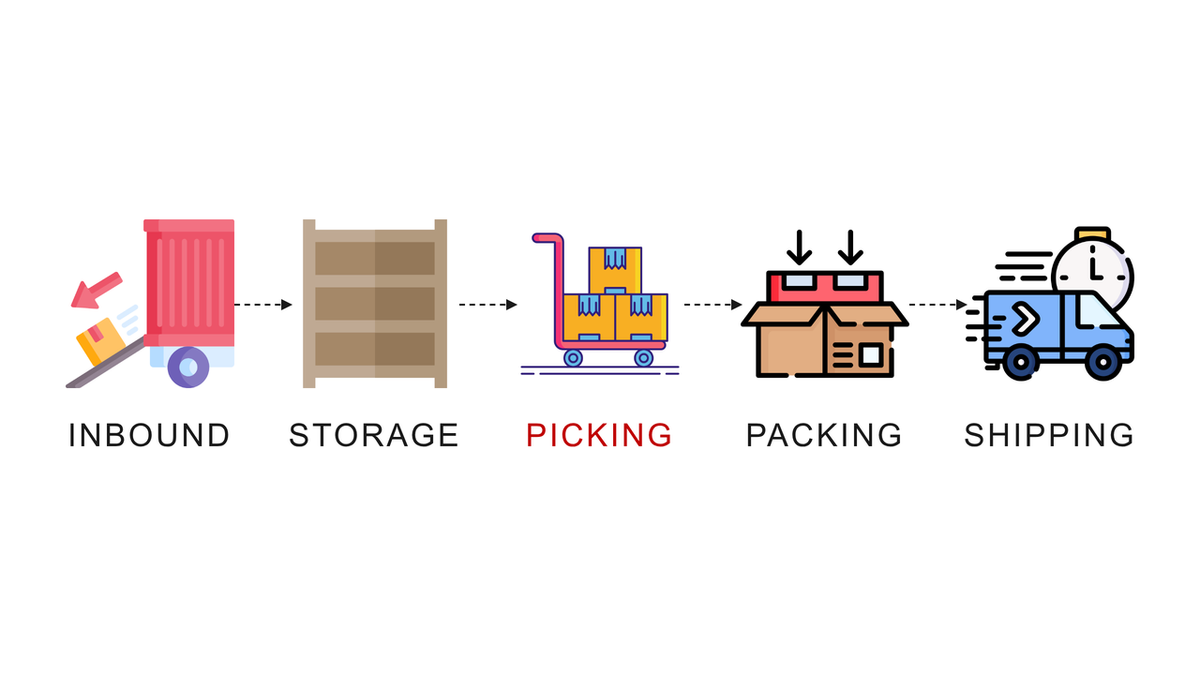
A warehouse is a building where goods stop moving for a while, and warehouse operations are the five processes that happen while they are stopped.
Goods come in through an inbound dock, get stored, get picked when an order asks for them, get packed, and leave through an outbound dock, and every one of those steps is paid for in labour.
In a distribution centre, walking from one picking location to the next can account for 60% to 70% of an operator's working time, which means the largest cost in the building is usually spent on nothing.
I spent the first part of my career designing and running these operations for fashion, luxury and consumer goods retailers, and later building the analytics that improve them.
In this article, I will explain the five processes of warehouse operations one by one, with the KPI that measures each and the lever that improves it.
Each one comes with a short explainer video and the case study where I implemented the improvement with Python.
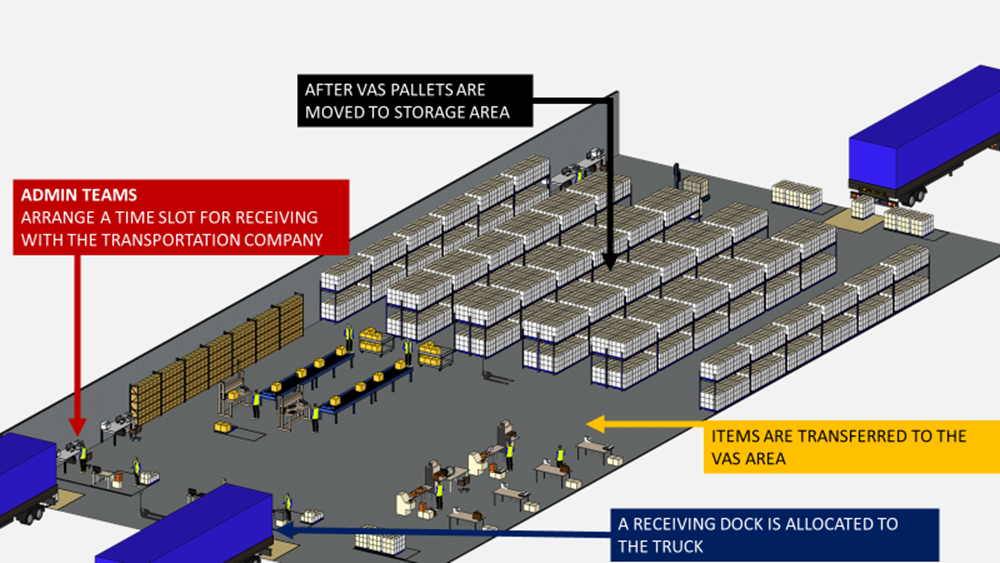
The scenario: a fashion retail distribution centre
Take the distribution centre of a fashion retailer, serving a few hundred stores and an e-commerce site from one building.
Pallets of finished goods arrive from factories, mostly by container, and leave as cartons on pallets for stores or as parcels for online customers.
On a normal day the picking teams handle around 5,000 order lines across 23 aisles, and 48% of those orders are a single line, one item, in one location.
Every one of the five processes below runs in that building every day, and each has its own team, its own KPI and its own way of quietly wasting hours.
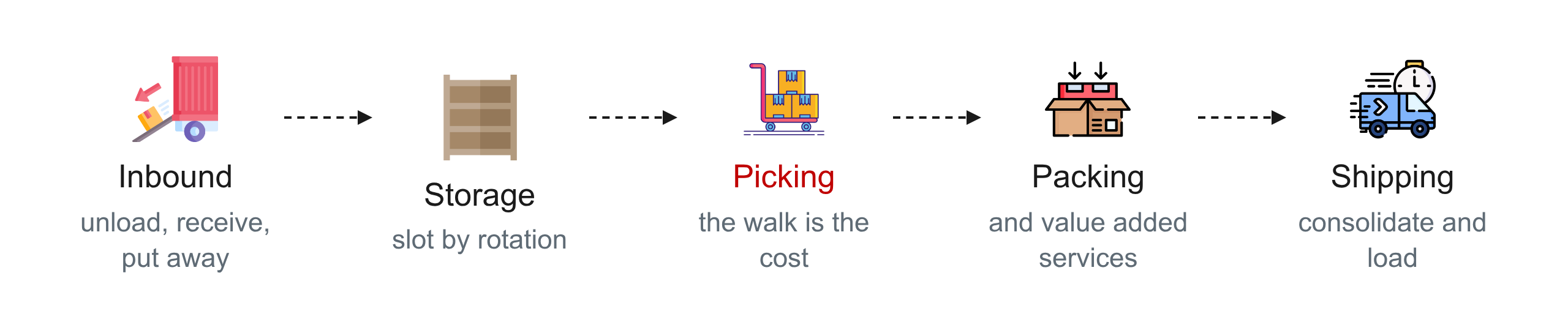
1. Inbound: unloading, receiving, value added services and putaway
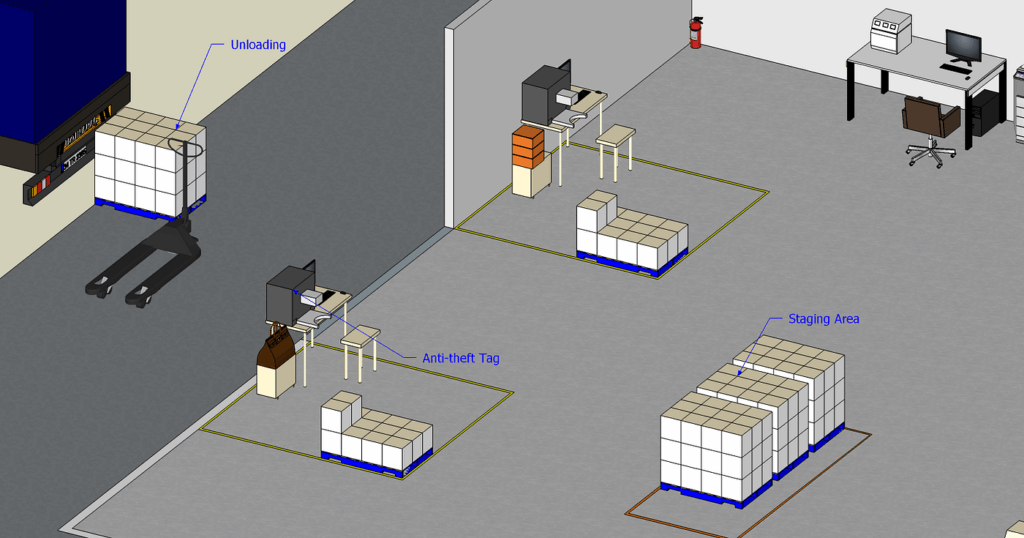
Inbound is everything that happens between a truck backing onto the dock and a pallet sitting in its storage location.
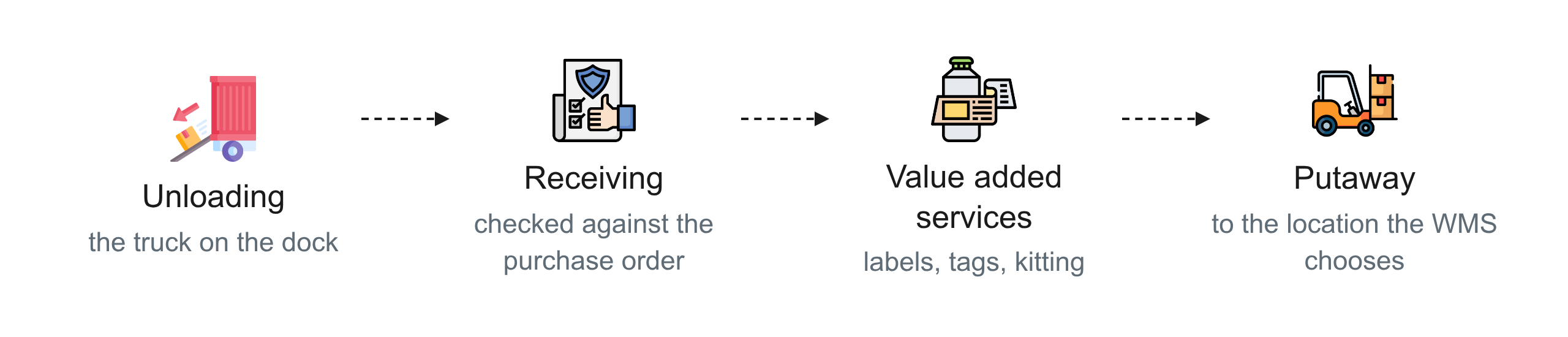
The truck is unloaded, and the goods are received against the purchase order and checked for quantity and quality.
Any value added services such as labelling or security tagging are applied, and the pallet is put away in a location the warehouse system chooses.
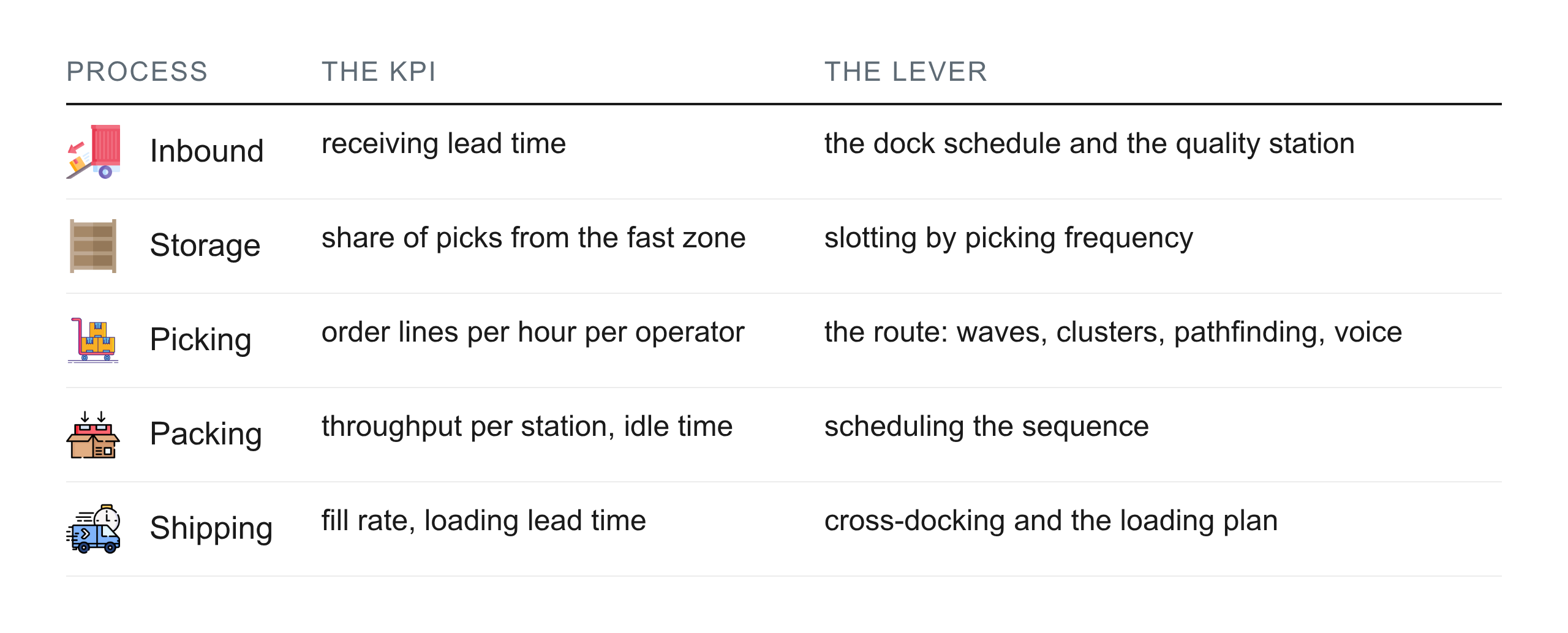
The KPI is receiving lead time, from the truck's arrival to the goods being available for picking, because until putaway is confirmed the stock does not exist for the order system.
The lever is the dock schedule and the quality check, because a receiving area with one workstation processes a container at the speed of that workstation whatever the size of the team.
2. Storage: layout, slotting and the Pareto principle
Storage is where the pallet waits, and the decision that matters is which location it waits in.
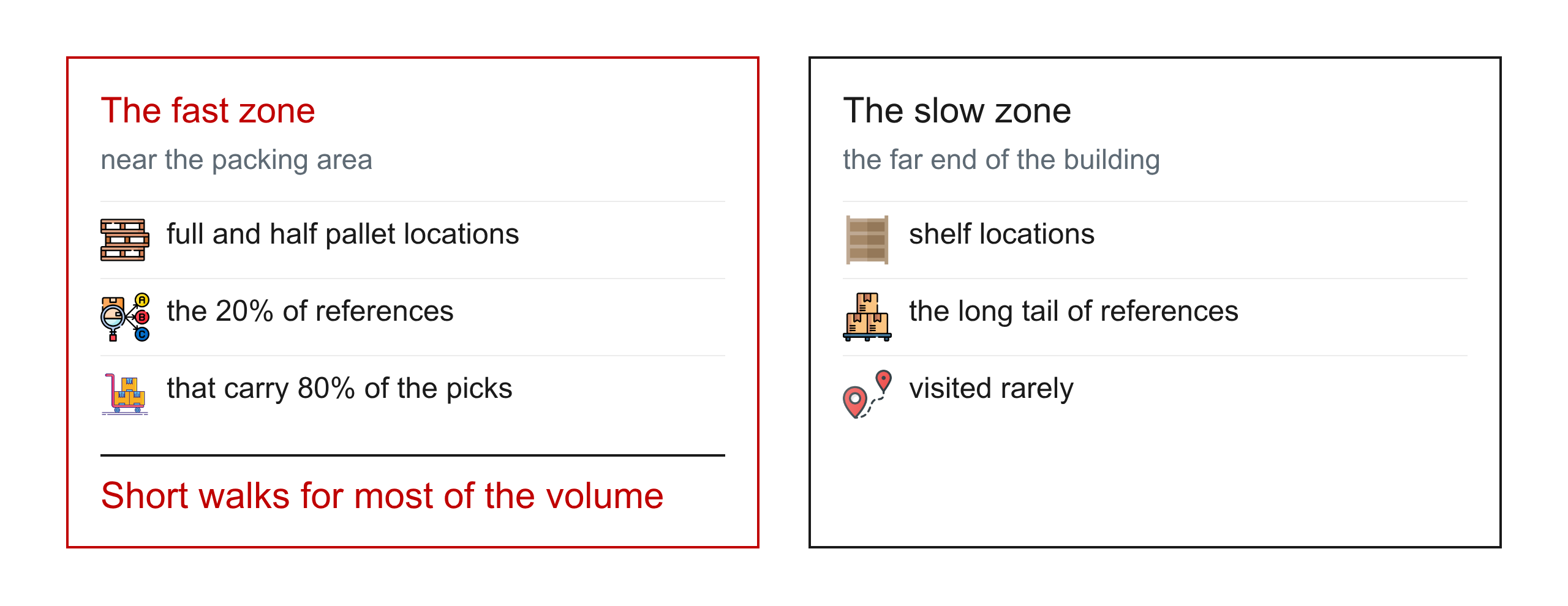
A warehouse has fast locations near the packing area and slow locations at the far end, and the products that move most should sit in the fast ones.
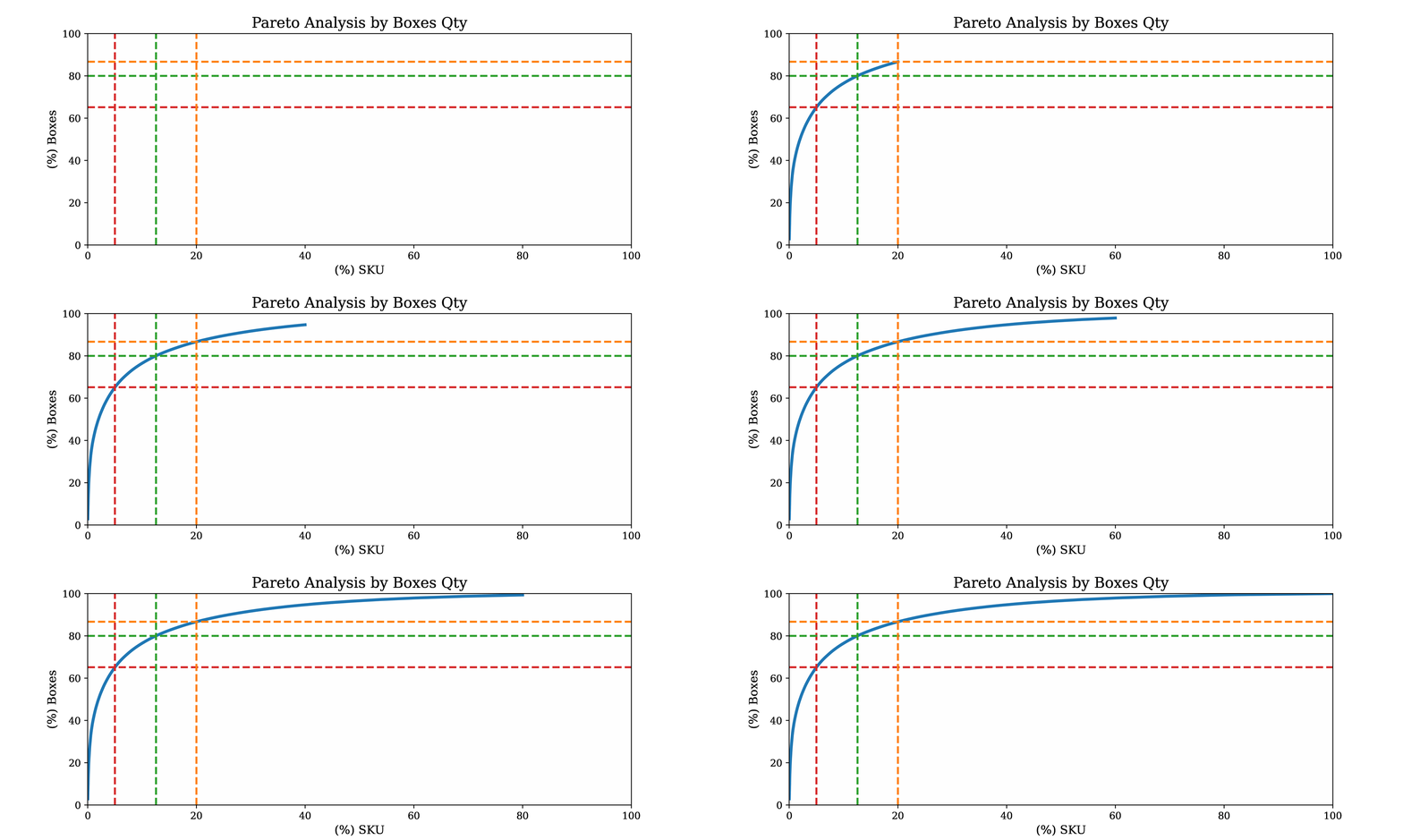
That is the Pareto principle applied to a warehouse: in most operations, 20% of the references generate 80% of the picking volume.
The KPI is the share of picks served from the fast zone, and the walking distance per order line that follows from it.
The lever is slotting, which means re-assigning locations by picking frequency, and I showed how to reduce warehouse space with the Pareto principle using Python, with full pallet locations for the top 20% and shelves for the long tail.
Sizing the building in the first place is a different problem, and I design layouts by cutting the floor into pallet-sized cells and counting them, before any 3D model is drawn.
3. Picking: handling units, order lines and the cost of walking
Picking is the process of collecting the items an order needs from their locations, and it is where most of the labour goes.
The vocabulary matters here, because a picking operation is measured in order lines, one line per reference per order, and each line is served in a handling unit: a pallet, a carton or a single piece.
The KPI is order lines per hour per operator, and the number behind it is walking distance, because in a distribution centre the walk between two locations is 60% to 70% of the picking time.
The lever is the route, and there are three ways to shorten it.
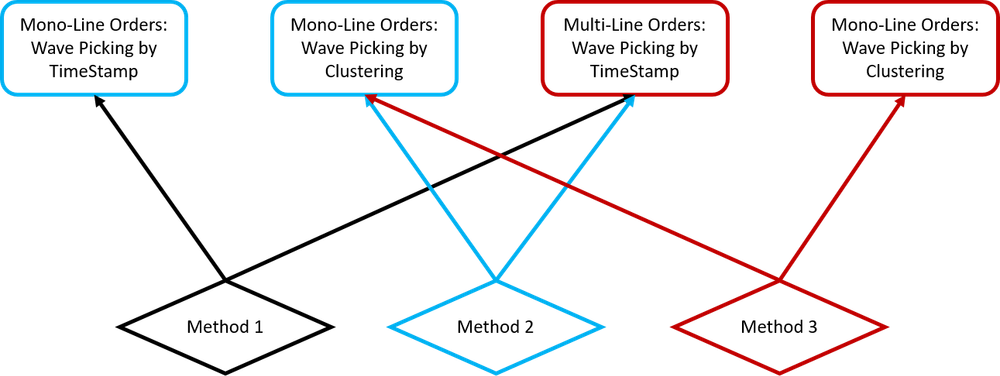
Wave picking, which groups orders into one route
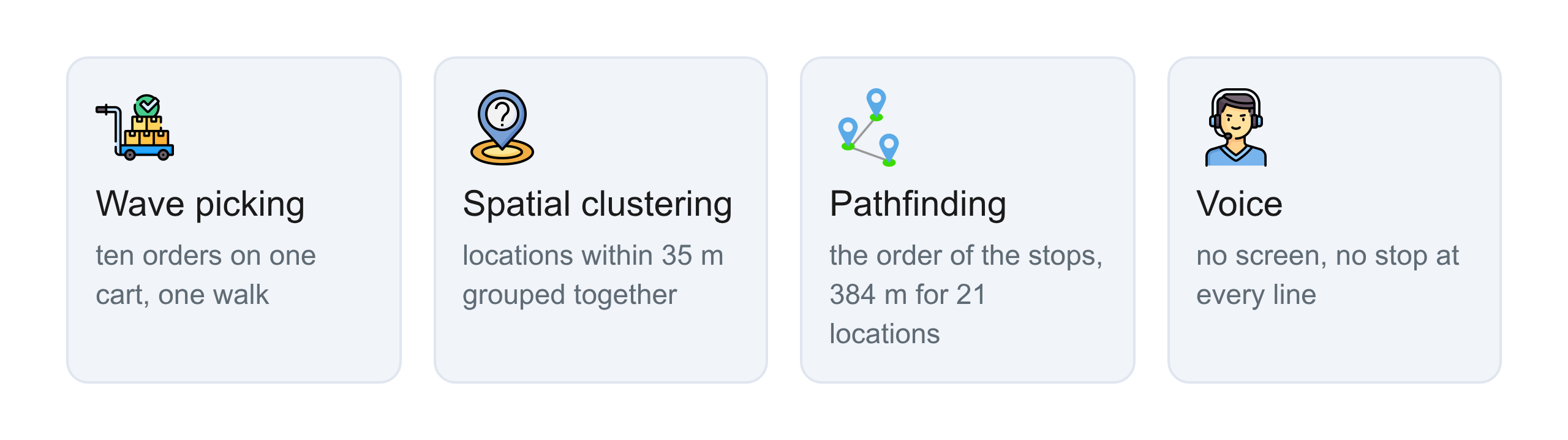
Instead of picking orders one at a time, a wave groups several orders into a single route with a cart, and one walk serves ten orders instead of one.
I measured this on 5,000 order lines, and going from one to eight orders per route cuts the total walking distance sharply.
The arithmetic is in The Hidden Cost of Walking and the Python build in order batching for warehouse productivity.
Spatial clustering, which groups locations that sit close together
A wave built from orders can still send an operator to both ends of the building, so the second step is to group orders by where their locations are, with a maximum walking distance between any two of them.
The spatial clustering case study builds waves from locations within 35 metres of each other, on the same 20,000 order lines.
Pathfinding, which orders the locations inside the route
Once the wave is set, the order in which the locations are visited is a travelling salesman problem, and solving it matters: on one wave of 21 locations, the optimised route was 384 metres against a longer naive one.
The pathfinding case study compares the nearest-next-location rule with an OR-Tools solver.
Voice picking, which removes the screen
The last lever is not the route but the interface: an operator reading a screen or a paper list stops at every line, and one who hears the location and confirms by voice does not.
I built a version of this with a language model behind the voice, and the ElevenLabs experiment is where the picking-list logic meets a smartphone and a headset.
4. Packing and value added services
Packing is where a picked order becomes a shipment, and value added services are everything a customer asks to have done to the goods before they leave: labelling, gift wrapping, kitting, security tags, certificates.
For a luxury retailer these services can be a production line in their own right, with several workstations and a sequence of jobs per order.
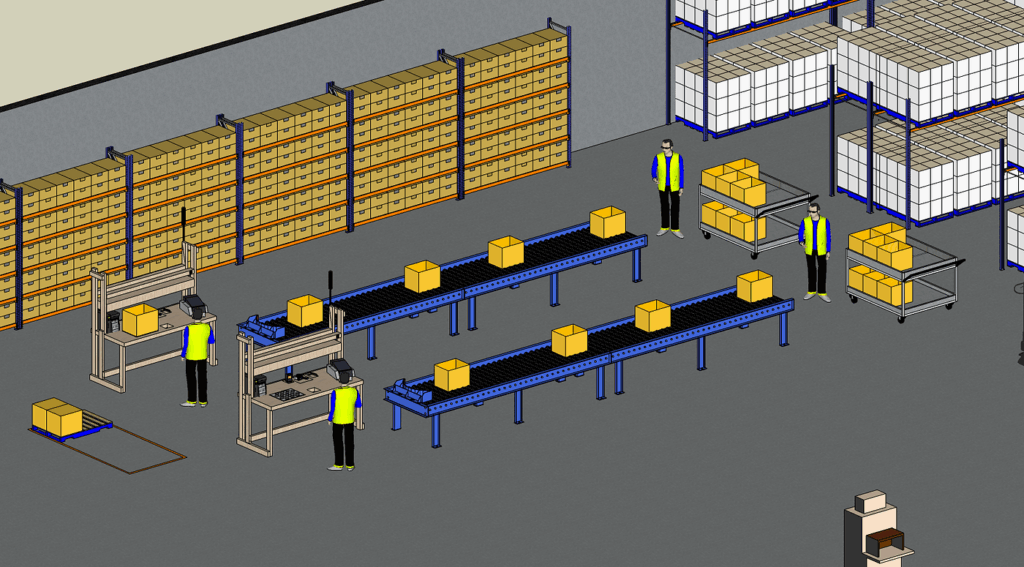
The KPI is throughput per station and the idle time between stations, because a chain of workstations runs at the speed of the slowest one and waits on every hand-over.
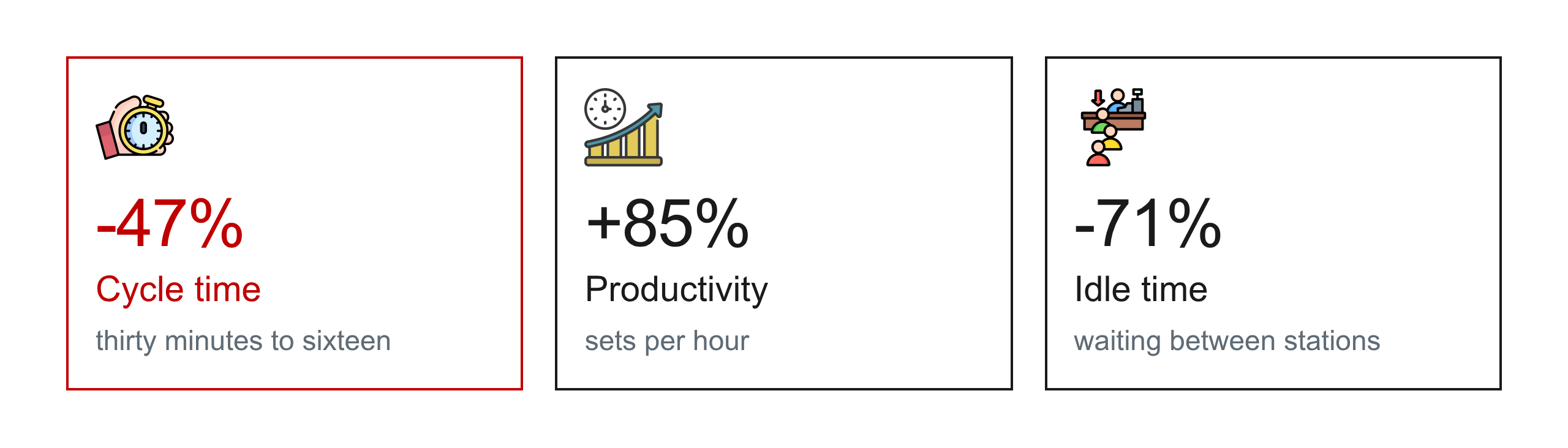
The lever is scheduling, and on a three-station value added services line for a luxury goods retailer, solving the job sequence with OR-Tools cut the cycle from thirty minutes to sixteen, a 47% reduction, with productivity up 85% and idle time down 71%.
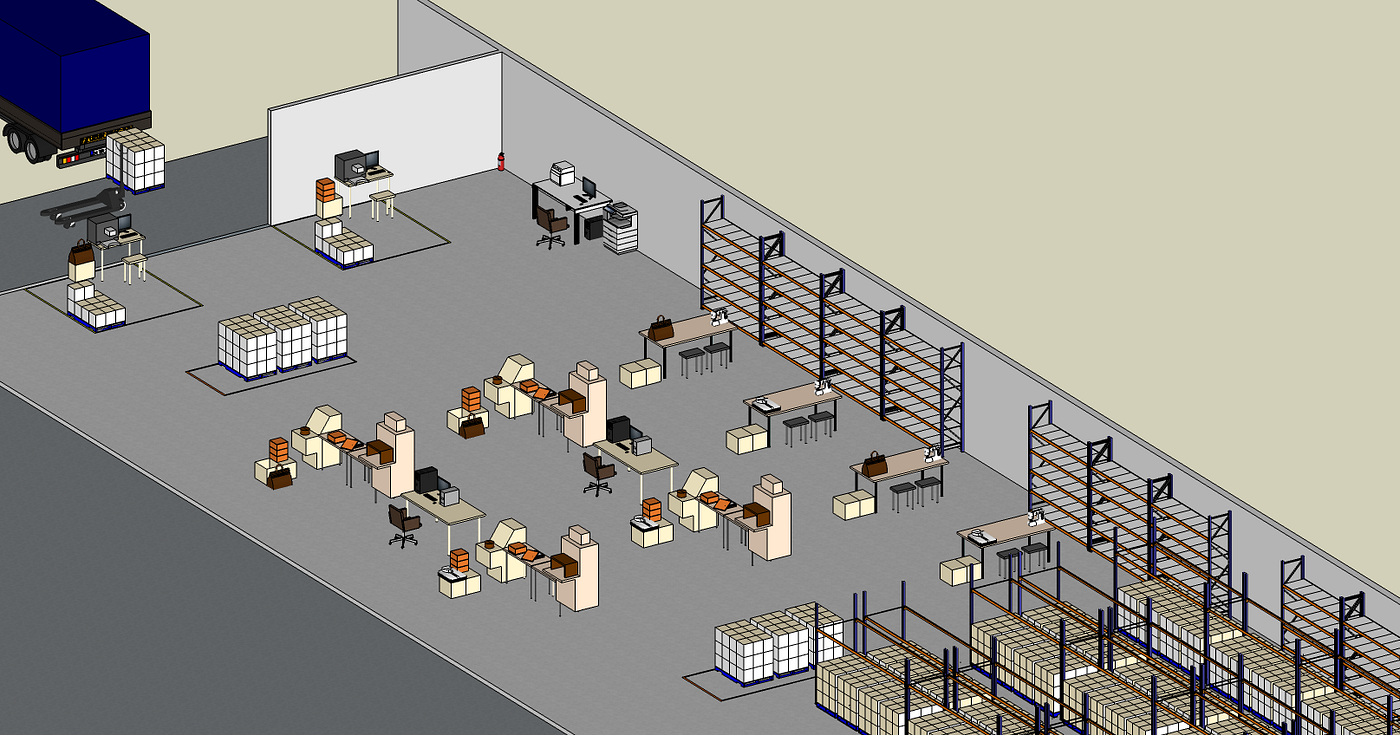
The build is in optimising warehouse value added services with Python, and the same scheduling method applies to any chain of stations.
5. Shipping: cross-docking, loading and the outbound dock
Shipping is the mirror of inbound: the packed orders are consolidated by destination, staged at the outbound dock, and loaded into the truck or the container.
Two things decide its cost.
The first is whether the goods needed to be stored at all.
Cross-docking moves them from the inbound dock to the outbound dock without a storage step, which is the right answer whenever the goods are already allocated to a store.
The second is how well the truck or the container is filled, because freight is paid per truck or per container and not per carton.
The KPI is the fill rate, and the loading lead time from the last carton being packed to the truck leaving.
The lever is the loading plan, and container loading optimisation with Python is a packing problem the solver handles better than the loading team's instinct does.
The KPIs that hold the five together
Each process has its own measure, and the operation is judged on one: whether the store or the customer received what they ordered, on the day it was promised.
That number is on-time in-full, and it depends on all five processes at once, which is why logistic performance management needs a timestamp at every step rather than a monthly report at the end.
A warehouse is measured by the truck that leaves, and improved by the five processes before it.
Conclusion
Warehouse operations are five processes, each with a KPI you can compute from the warehouse system and a lever you can test with data before you change anything on the floor.
What we covered in this article
Inbound and the receiving workstation that sets its pace, storage and the Pareto layout, picking and the three ways to shorten the walk, packing and the scheduling that removes the waiting, and shipping with cross-docking and container loading.
Where to go next
If you are new to the vocabulary, the explainer videos above are two to four minutes each and cover the whole flow in under twenty minutes.
If you already run an operation, start with picking, because the walking distance is where the money is, and the batching article gives you the arithmetic to make the case.
And if you would rather test yourself first, the Supply Science App has a quiz on each of these processes.
Related videos
The videos behind this article, already on the channel:
- Understand Warehouse KPIs: From Inbound to Outbound
- 20% of Your SKUs Are Doing 80% of the Work
- Two Identical Warehouses: One Was Losing Money
- Warehouse Process Scheduling with Python
- Understand Warehouse Performance
The ones coming next, with the date each goes public:
- Order Batching: 70% of a Picker's Day Is Walking, 5 October 2026
- Container Loading: From 76% to 84% Fill Rate, 2 December 2026
- What Warehouse Receiving Is, 30 December 2026
- Storage Location vs Picking Location, 13 January 2027
- The Pareto Rule for Warehouse Layout, 27 January 2027
- Warehouse Productivity KPIs, 10 February 2027
About Me
Let's connect on LinkedIn and Twitter. I am a Supply Chain Engineer who is using data analytics to improve logistics operations and reduce costs.