How to Avoid AI Replacement: Learn the Skills It Cannot Replicate
Now that AI masters statistics and builds the algorithms I spent years learning, it is time to reflect on where our value lies and how to stay relevant in an agentic era.
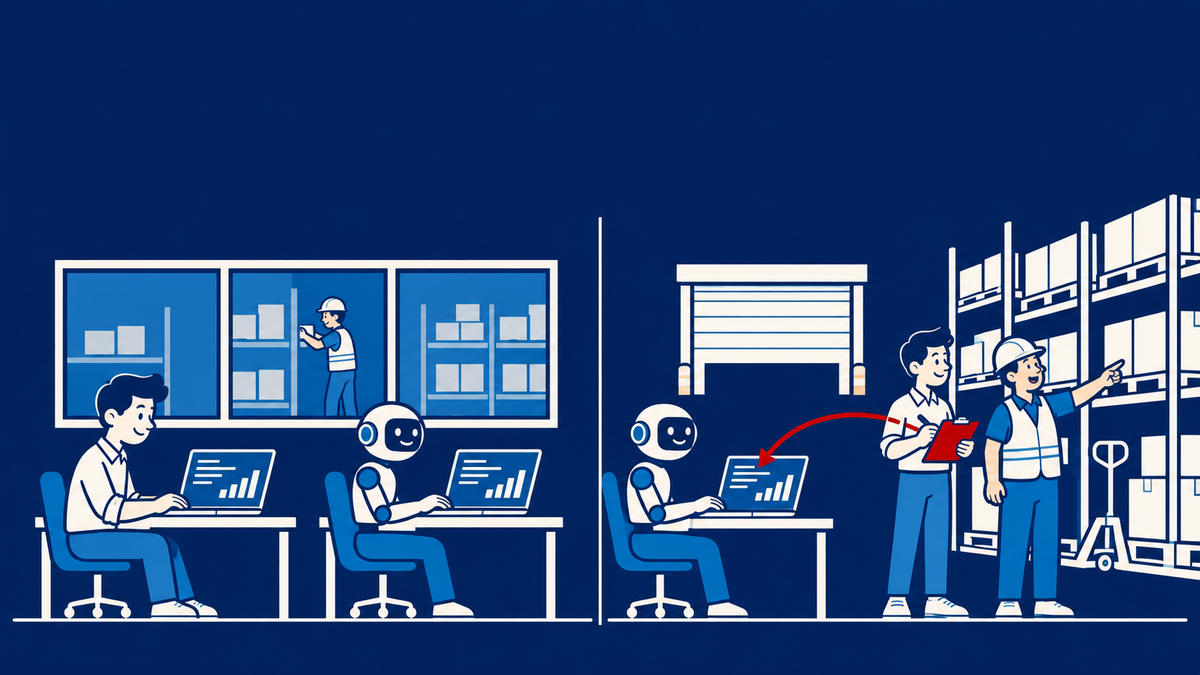
I still remember how excited I was the first time I used Claude Code.
From a single prompt, it adapted an algorithm I designed years ago to my current project and deployed it on my server, ready to connect to the customer’s Google Sheets.
It was a game changer, giving me a semi-automated way to productise and deploy any optimisation algorithm I took months to develop.
At the time, I was excited by the productivity gains this brought.
Now, 18 months later, I wake up every day with the question: “Where is my value, and how do I avoid being replaced by AI?”
AI agents now handle a growing part of the analytics value chain, so I had to work out where I remain relevant as a supply chain and analytics expert.
Fortunately, my experience implementing AI for manufacturing and logistics operations taught me that these projects rarely meet automation expectations.
I have seen a planner drop his AI assistant for Excel because it answered the same question differently each day, and teams in one company measure the same KPI in 36 different undocumented ways.
No agent could have solved these on its own, and this is our chance (as analytics professionals) to stay relevant.
My goal for 2027: make sure that I don't become what we call a "meat proxy", a human whose only job is to pass requests to an AI and its answers back.
In this article, I will share my experience managing agentic projects in mid-size and large companies to show the limits of AI in a corporate environment.
This will help us to understand the fundamental skills AI cannot replicate:
- Learning the whole chain your data passes through: how data is generated, transformed and used in corporate systems
- Turning a request into the tool the team actually needs
I will conclude with my personal advice on how to build these skills using the free resources I share on this blog.
Implementing AI taught me what its limits are
For context, I am a supply chain professional who learned data science to help manufacturing and logistics operations optimise their processes for profitability and sustainability.
Since 2020, I have shared real use cases in this blog where analytics helps solve an operational or business problem.

At the time, the idea was to educate supply chain professionals on using data science to solve the problems they face in their companies.
Interest was huge: data science was an opportunity to use advanced mathematics to create value for companies.
But since 2025, the focus has shifted to using AI to build workflows where agents are supposed to autonomously handle very complex business and operational processes.
Unfortunately, in the projects I have seen, these solutions fail to deliver on their promise.
Why?
Because the systems (ERP, CRM, WMS, ...) that run a company are, unfortunately for analytics and AI experts, not plug-and-play solutions for models that require harmonised, cleaned data.
Obstacle 1: AI cannot guess how systems are used by only looking at the database
The first obstacle companies deploying AI solutions face is the mapping of the processes, what we now call ontology.

In a typical consumer goods company, systems managing manufacturing, logistics, finance and HR do not represent a monolithic bloc with a central source of documented data.
Most are legacy systems, with many specific developments over the years to meet the needs of teams that generate and use data their own way.

Let me illustrate with an example from a project at a consumer goods company.
My role was to design a tool to find the root cause of late store deliveries.
This started with a simple task: defining whether each delivery was on time or late.
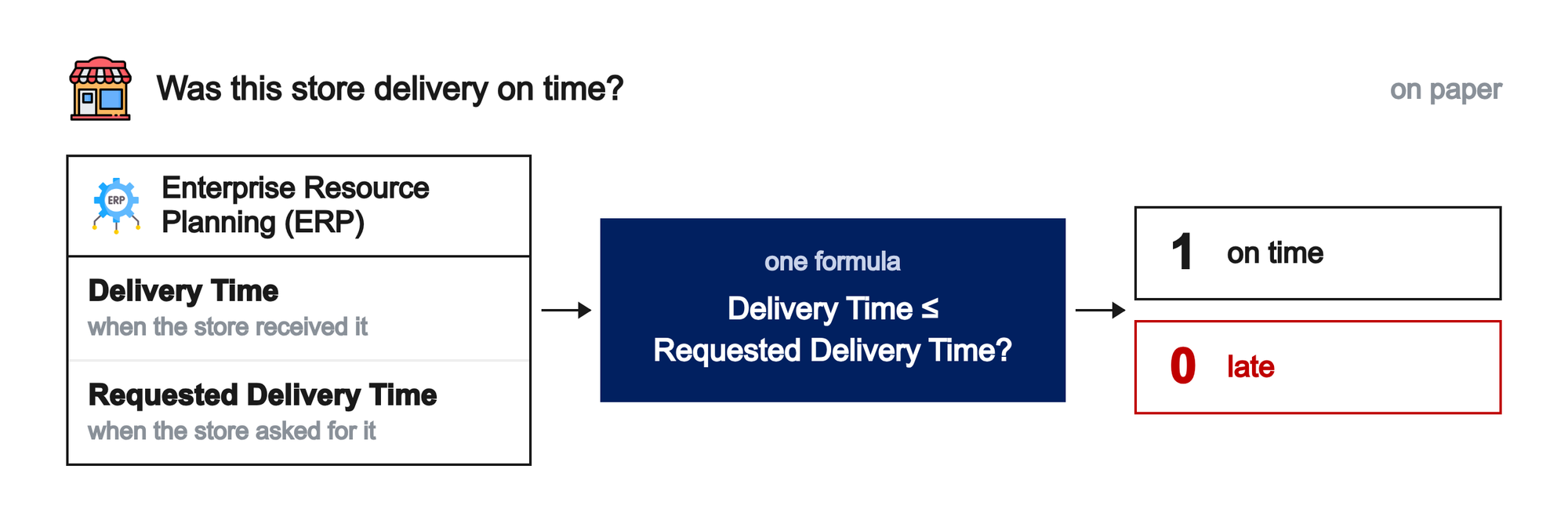
On paper, the formula is simple: take the field named Delivery Time in the Enterprise Resource Planning (ERP) and compare it with the field Requested Delivery Time to generate a boolean (1 if on time, 0 otherwise).
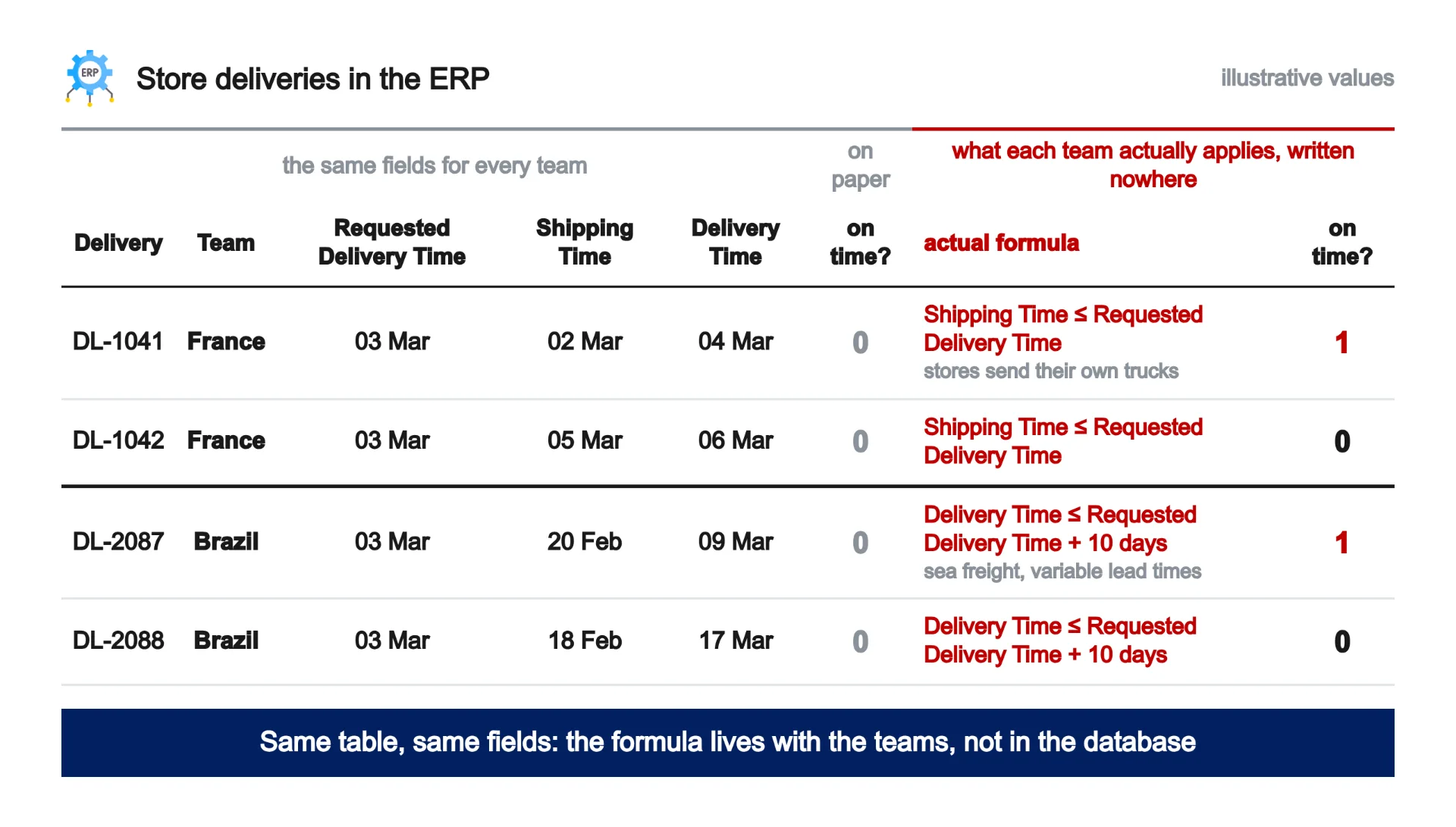
After 12 weeks of workshops with the logistics teams, I discovered that they used 36 different ways to define this boolean.
For example:
- France teams take the Shipping Time because stores send their own trucks
- Brazil team flags a delivery as late only if the shipment arrives 10 days after the Requested Delivery Time because they use sea freight that has variable lead times

These edge cases aren't documented anywhere.
They require a human, myself, to ask other humans and translate their answers into a model of the data transformations performed inside and outside the systems.
An AI agent can't sense this complexity by looking only at transactional data in the database.
This requires human soft skills that agents do not have yet:
- Build connections inside a company to have access to the right person who has the information you need
- Lead and structure workshops with operational and business teams to collect the right information (e.g., how do you define a late store delivery?)
- Industry experience that is often not documented online (e.g., I knew the same field in the ERP can be used differently by two teams based on my past projects)
If you extract this knowledge from the team, you have built the foundation to implement any analytics or agentic products connected to the company's systems.
Unfortunately, deploying solutions isn't always enough to drive user adoption.
For more details about this project, I explain everything in this video
Obstacle 2: AI models are stochastic, and this can be a problem when users need robust solutions
In the data science world, we quickly learned that large language models (LLMs) can produce different outputs for the same input because of their statistical nature.
But this behaviour rarely fits environments where predictability and reproducibility are key.
A manufacturing company contacted me after equipping its planning teams with AI assistants to support their daily tasks.
Their supply chain director wanted to enable his planners to create automated workflows with tools like Claude Cowork to pull data from an Excel file and answer strategic and operational questions:
- How many units should we produce next week to meet customer demand?
- How many production batches do we need to reduce the inventory by 15%?
His idea was to implement analytics-as-a-service with agents that would answer planners’ questions on demand.

Supply Chain Director: “It became operational chaos.”
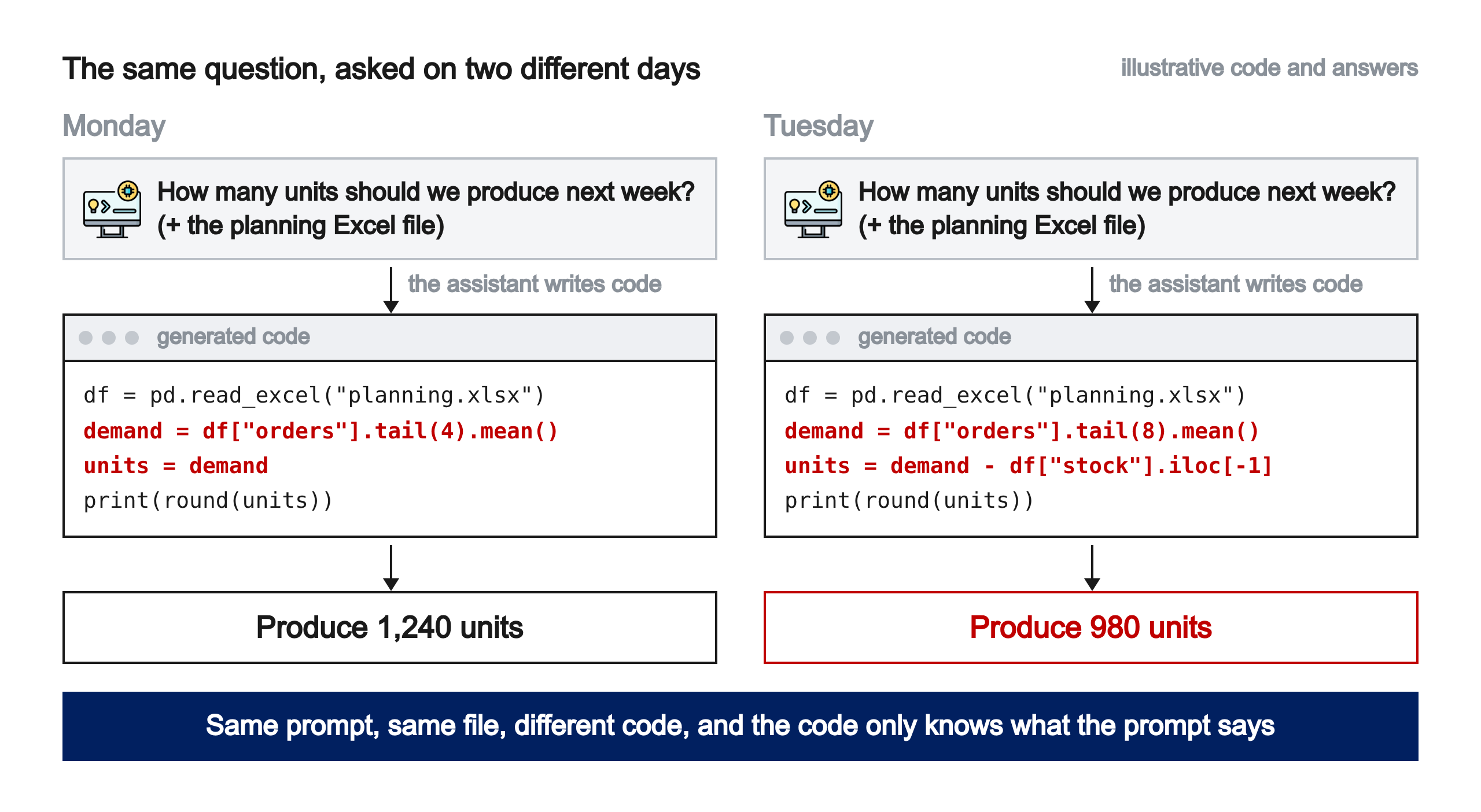
A planner admitted she switched back to her Excel planning spreadsheet because “AI can give me different outputs for the same question from one day to another.”
We looked together at the different analyses generated by the agent and discovered that, for the same question and the same input Excel file, it generated two different Python scripts.
I decided to organise workshops to understand the needs of these planners, asking:
- What type of analyses do they need?
- What input and output data are involved?
- Which tasks require full automation and why?
The conclusion was clear: they did not need AI.
Analytics and data science tools written with deterministic code can exactly meet their needs:
- Inventory management rules written in Python, explained in this article, to find the minimum safety stock of raw materials required to meet production lines’ needs
- Dynamic algorithms like Wagner-Whitin can tell them how many units to produce in each batch to deliver customer orders while avoiding accumulating too much inventory
These solutions are deterministic (run them 100 times and you will always get the same output) and designed by a human (myself) who took the time to understand the operational context and their internal and external constraints.
Supply Chain Director: “We needed someone to challenge our requests, propose a structured process to generate insights from data and design robust tools we can rely on.”
To illustrate how little they understood about how AI works, the director was surprised when I explained that the assistant was also generating code to answer his planners’ questions.
The other problem was that agents only had the context the planner shared in the prompt, while on my side I spent hours asking his team hundreds of questions.
These two examples had one thing in common: a highly skilled engineer could compensate for AI's limits and unlock situations by translating operational and business requests into analytics solutions.

These are the skills that will keep you relevant as companies introduce agentic workflows into more and more processes.
The question now is: How do you develop these skills?
In the next sections, I share my vision, based on dozens of analytics and AI projects.
Skill 1: Learn the whole chain your data passes through
In the first example, we learned that we can’t understand how a company is run by looking at transactional records in a database.
The first skill I developed comes from my years as a continuous improvement engineer: understanding a process end to end.

When I was working in the logistics industry, I often understood the customer’s supply chain better than their own teams.
I found out by asking them how their processes worked, and they could not answer.
Why?
Because my role was to develop a holistic view: understand how warehouse and transportation operations work as one chain.
Each person in front of me thought about their own step.
As an analytics expert, you need to follow data along its life cycle:
- Input: how data is entered into the systems
- Processing: how information is stored and updated in the systems
- Output: how teams read the data and what they do with it
This framework will help you structure your workshops, ask the right questions of the teams, and set expectations before you start building the solution.
You don't need ten years of supply chain experience to ask the right questions.

Let’s go back to our FMCG company with its 36 formulas to measure if a store has been delivered late:
- Input: the requested delivery date is included in store orders and may be modified by customer service admins if the customer asks for a new date
- Processing: French teams have implemented a script that modifies the requested delivery date if the delay is below the service level agreement (SLA)
- Output: American teams do not look at the delivery date but at the actual ship date when flagging late deliveries because they are not responsible for transportation
These three points summarise 12 weeks of intense workshops with the teams to extract all this knowledge.

The supply chain director was surprised by the complexity of his distribution chain and admitted that no one in the company expected measuring on-time delivery to be so complex.
My question to you: “Do you think that plugging Claude Code into the SQL database of the ERP would help to get these insights?”
No, in most of the AI projects I've seen, we still needed someone who knows what each team takes in, changes, and hands to the next.
In most organisations I've worked with, this person doesn't exist, which makes this a management problem more than a technical one.
Therefore, companies will always need someone with analytics skills who can collect process knowledge from business and operational teams, structure it, and translate it into data that agentic workflows can use.
Skill 2: Turn the request into the tool the team needs
I am convinced companies don’t need stochastic parrots designed to say yes to any user request.
Therefore, the second skill you need is translating (and challenging) a business request into the tool the team needs.
Let me go back to the second example: the planners’ AI assistants answered their requests based on a limited context.
They didn't ask for additional information or run a workshop to clarify the needs; they generated the most probable output from the prompt text.

And they didn't challenge the request: the planners didn't need ad hoc analyses generated by code rewritten each time.
An AI assistant answers the request; it does not ask if it is the right one.
Let me illustrate this with a project I did with a mechanical parts manufacturer in Switzerland.
The supply chain director found me through my article about production planning optimisation and asked for a similar solution to reduce their costs.
At that time, he could have asked Claude Code to pull the Python implementation of the tool I shared on my GitHub and run it with their data.
They needed a unified process, not a magic algorithm.
But when I looked at how planners worked, the algorithm was not the first problem.
Customer orders arrived by email, directly from customers or from the commercial teams, in one mailbox per planner group.

Planners then created production lots by hand in Excel, often with too much inventory or too many batches, because orders for SKUs that could share batches weren't grouped.
Instead of a standalone algorithm, we designed a procedure in three steps, each validated with the planners before the next:
- Data: all customer orders collected in one place, Anaplan, instead of one mailbox per group of planners
- Optimisation: a Wagner-Whitin lot-sizing algorithm grouping the orders of SKUs, or families of SKUs, that can share batches
- Adoption: the optimisation runs inside the planners’ daily workflow, with a dashboard and an email workflow, instead of being a separate tool

This answered their needs: production costs are estimated to drop by 30%, mainly thanks to lower inventory.
Because the optimisation is deterministic code packaged as a service, other teams reused it for their own simulations, with a central logging system to track all the analyses.
A coding assistant would write the algorithm they asked for and would not question the process.
Before you build anything, ask what decision the tool will change and who will make it.
So far, the agents don’t do this.
That is why I believe this skill matters if we want to be antifragile in this new AI-first era.
But how do we develop these skills?
Learn the processes and operations behind each model
These skills come from years of experience designing and optimising supply chain solutions across 60+ international supply chain operations in Asia Pacific and Europe.
When I started my career, I couldn't learn these skills from a book or a YouTube channel.
Therefore, I started this blog and my YouTube channel, Supply Science, to share this operational experience with the data science community.
You can find a playlist of 5-minute videos in which I introduce 25+ analytics and data science concepts with:
- An introduction to a real-world operational and business use case explained to an audience with no experience in the domain
- A statement of the problem we want to solve using operational terms you will face in your future AI implementation projects
- A detailed approach to design and deploy the solution, ensuring user adoption and operational impact
- The source code and the anonymised dataset
These short tutorials are meant to help you improve your operational and business culture while strengthening the skills needed to avoid being replaced by a stochastic parrot that generates code.
Do not forget the reflexes mentioned in the article:
- Don't let yourself become a "meat proxy" of a stochastic parrot: always challenge the requests and ask dozens of clarifying questions before building anything (unlike Claude, which will build anything from an incomplete prompt)
- Make sure you map with the teams the entire data life cycle from the system's inputs, transformations, to how teams use the outputs to make a decision
If you follow these guidelines, you can start 2027 confident you won't be replaced by an agentic workflow.
About me
I am Samir. I have ten years of supply chain experience across Asia and Europe, and I learned everything above from that rather than a textbook.
I build the analytics and AI tools at LogiGreen, and I record what I learn on Supply Science.
The rest is on my blog, and let’s connect on LinkedIn and Twitter.