The Supply Science App: 950+ Questions to Take You From Beginner to Supply Scientist
Free and built with my brother: quizzes by career track, video lessons, the case studies and code behind them, and a badge ladder that ends above the CEO.
Every week I receive the same message, in a LinkedIn DM, under a YouTube video, or in a GitHub issue on one of my repositories.
"I want to learn supply chain analytics, I found your blog, and I do not know where to start."
It is a fair question, and for a long time my answer was embarrassing, because I would send a link to one more article and hope the reader found their own way from there.
I have published more than 90 case studies here and over 150 videos on the channel, and none of it was ordered into anything a beginner could follow.
Worse, I had no way of knowing whether anybody had understood what they read, and neither did they.
Reading a case study is not the same thing as being able to do it
A tutorial can be read in fifteen minutes and forgotten in a day, because reading is passive and nothing tests whether the concept landed.
The people asking me where to start did not need more content, they needed a path through the content that already existed, and a way to check their own level along the way.
So my brother and I built one, and it is free.
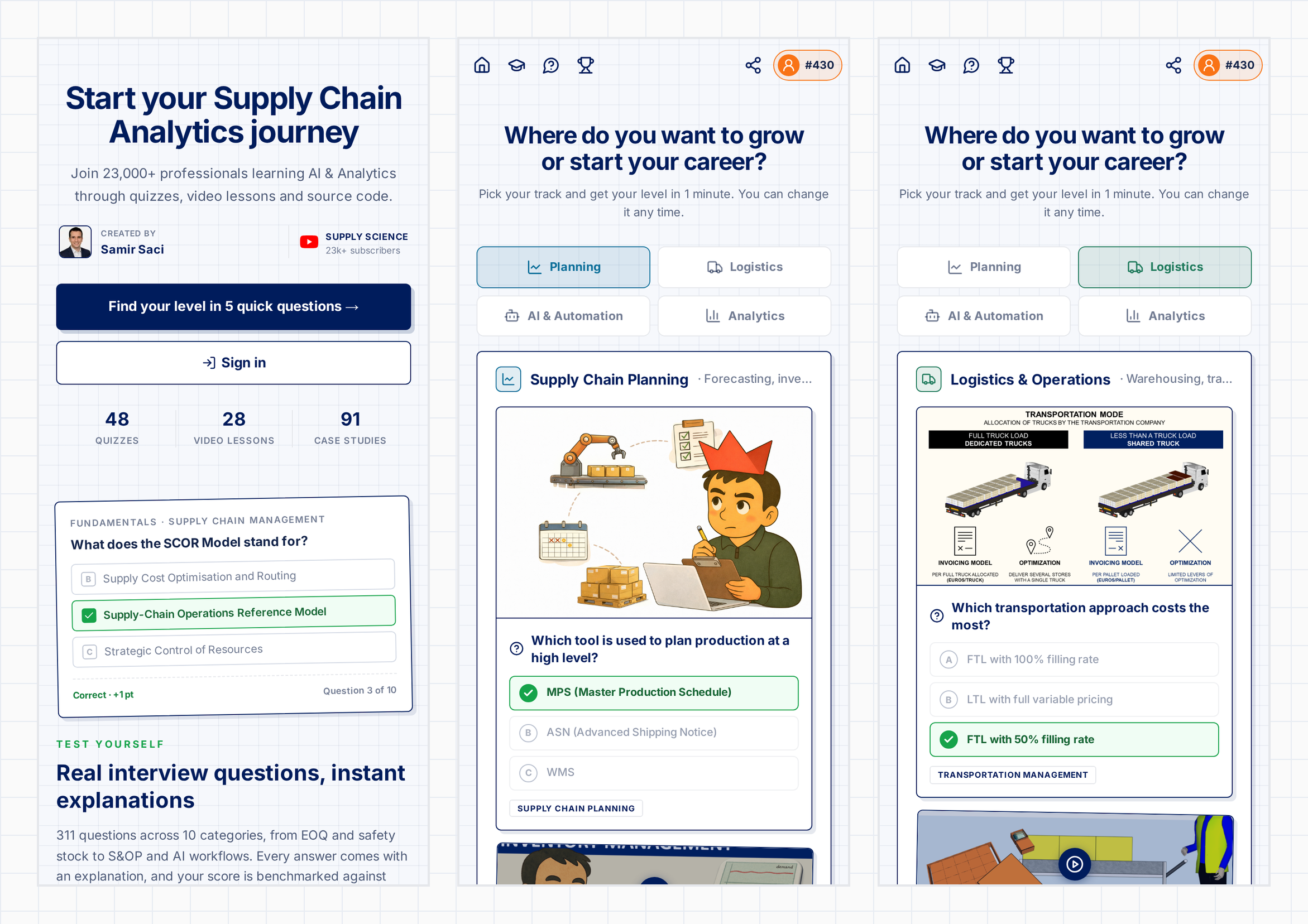
In this article, I will present the Supply Science App feature by feature:
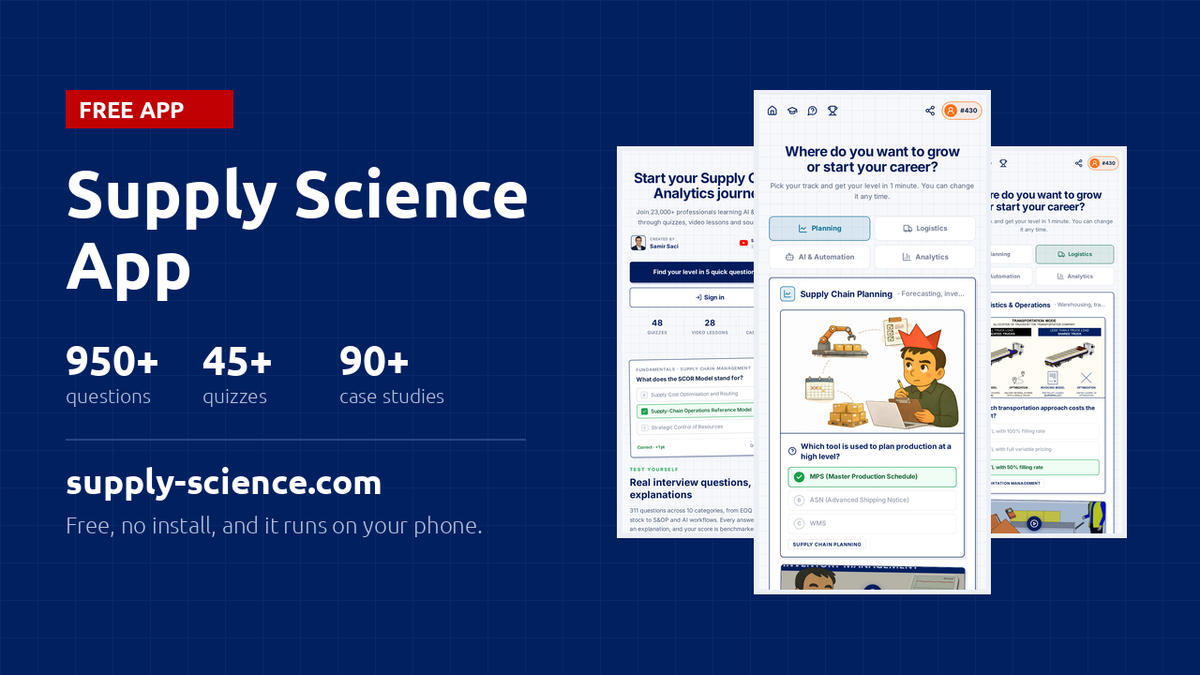
- Quizzes by career track, more than 950 questions across 45+ quizzes, from supply chain fundamentals to CPIM, CSCP and CLTD certification preparation.
- Video lessons, organised into 20+ categories, each one closed by a quiz that checks you understood it.
- The case studies and the source code behind every concept, so you can run it on your own data.
- A badge ladder of ten levels, from Supply Beginner to Supply Scientist.
- A question feature that reaches me directly, with the article you were reading attached to it.
Everything below is live today at supply-science.com, in your browser, with no installation and no payment.
The problem I had built for myself
The blog started in 2020 as a place to publish the analytics I was building for logistics operations, one case study at a time.
Six years later it covers inventory management under stochastic demand, warehouse order batching, transportation network analysis and sustainability reporting, and that breadth is exactly the problem.
A reader arriving from a Google search lands on one article about the Pareto principle, finds it useful, and has no idea that a dozen more articles build on it.
The catalogue was a library with no shelves and no librarian.
The second problem was harder, because it is the one nobody complains about out loud.
When somebody finishes a tutorial, neither of us knows whether they can now do the thing, and without that signal there is no way to tell them what to read next.
A quiz solves both at once, because a wrong answer is a precise diagnosis of what to revise, and it points at the lesson that covers it.
Start by finding your level in five questions
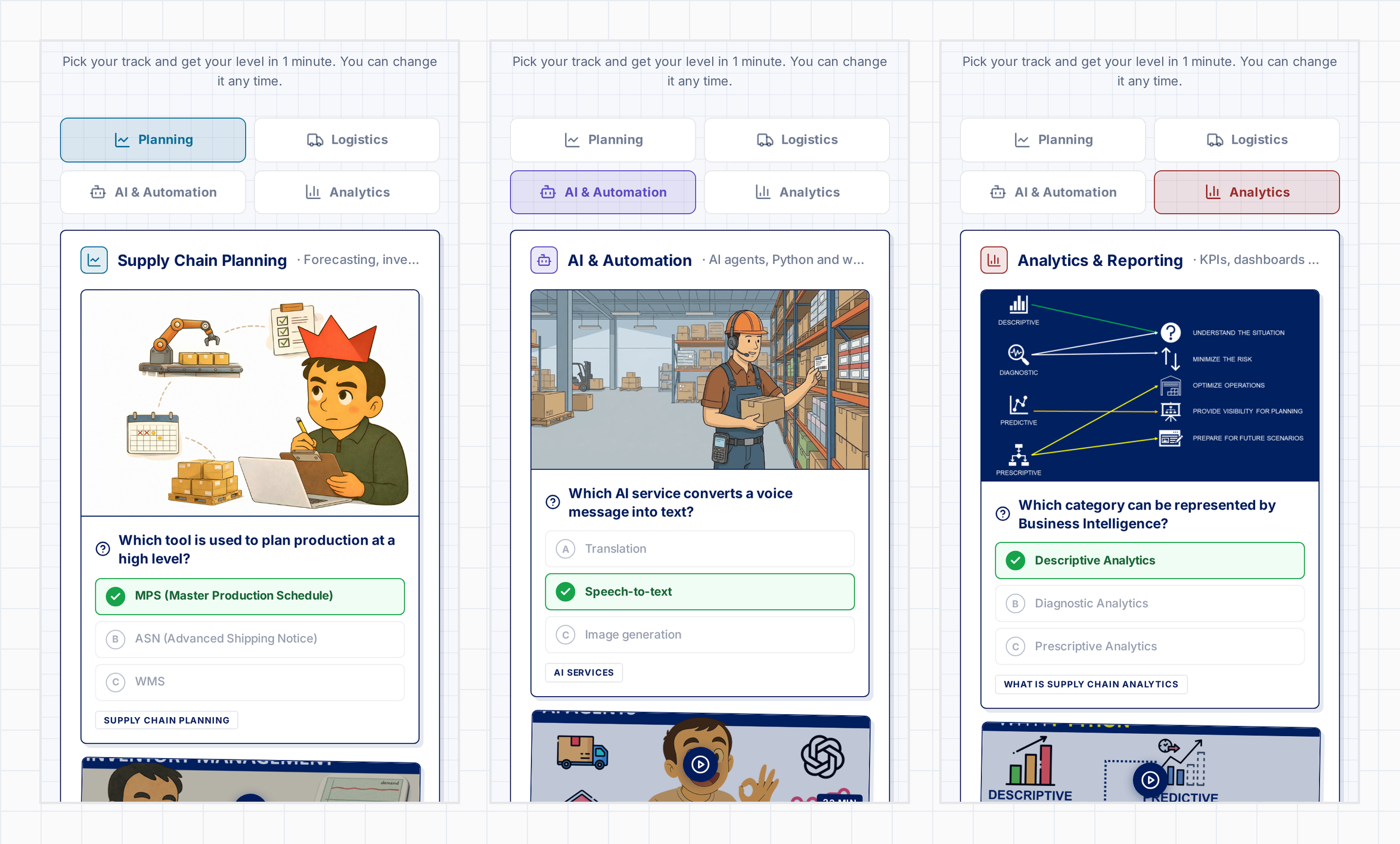
The app opens on a five-question assessment rather than a sign-up form, because asking somebody to create an account before they have seen anything is how you lose them.
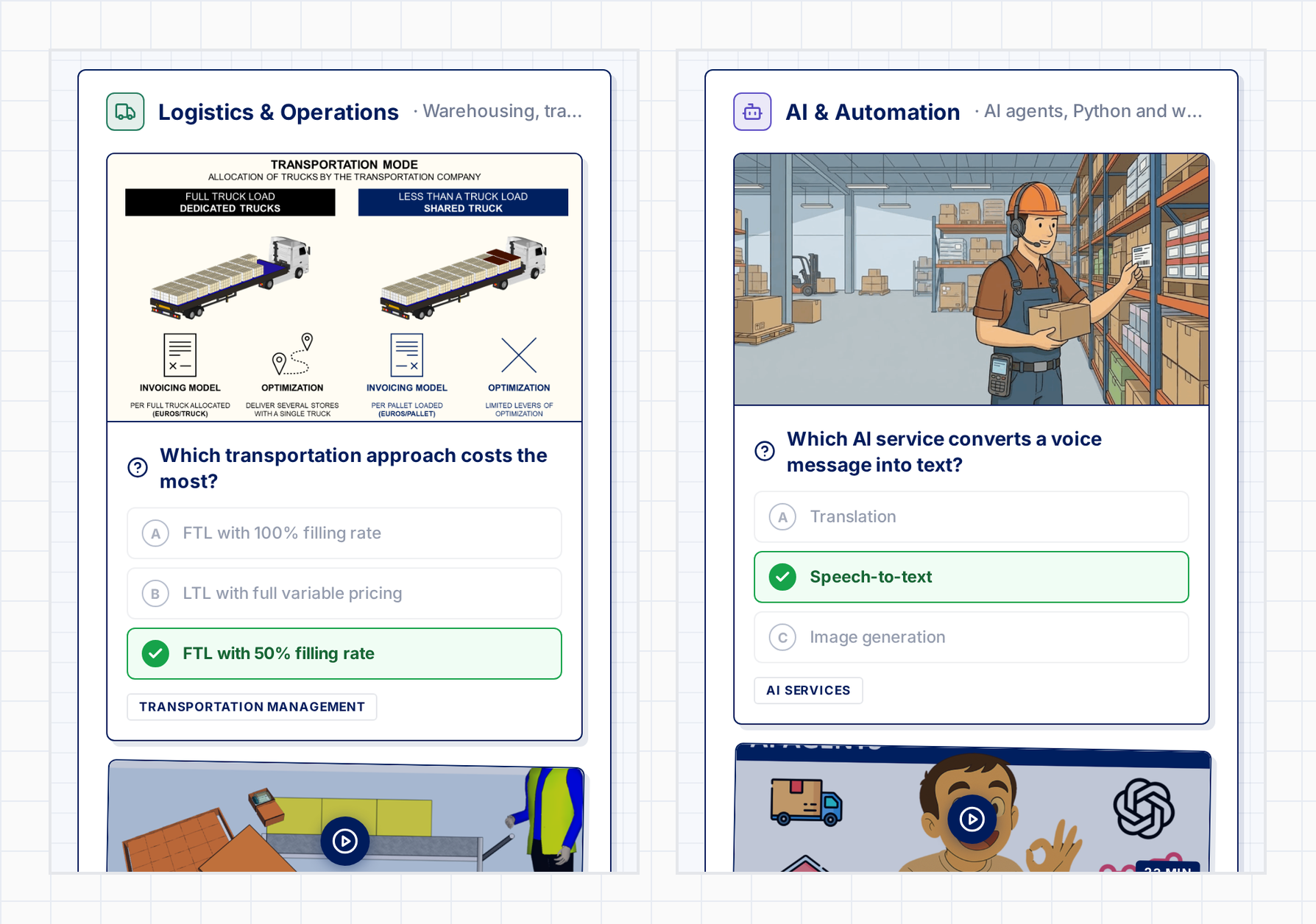
You pick one of four career tracks, and the questions come from that track.
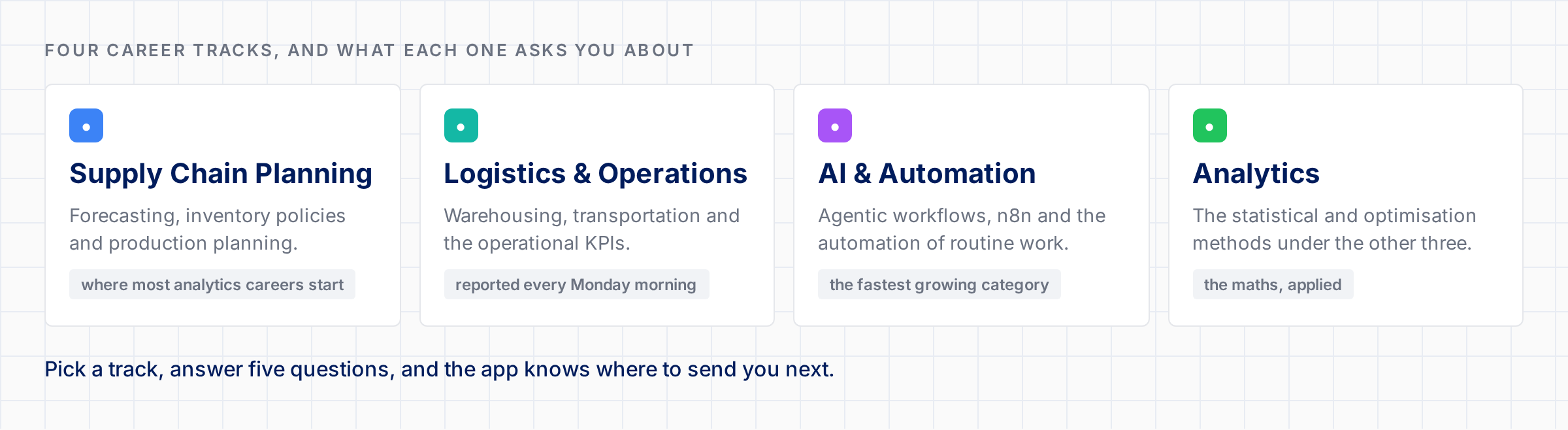
The four tracks
Supply Chain Planning covers forecasting, inventory and production planning, which is where most analytics careers in this field actually start.
Logistics and Operations covers warehousing, transportation and the operational KPIs that get reported on Monday morning.
AI and Automation covers the agentic workflows I have been building with n8n, which is the fastest growing category on the channel.
Analytics covers the statistical and optimisation methods underneath all three of the others.
Every question shows the correct answer immediately, with the reasoning behind it, because a quiz that only gives you a score at the end teaches nothing.
Then the deep dives
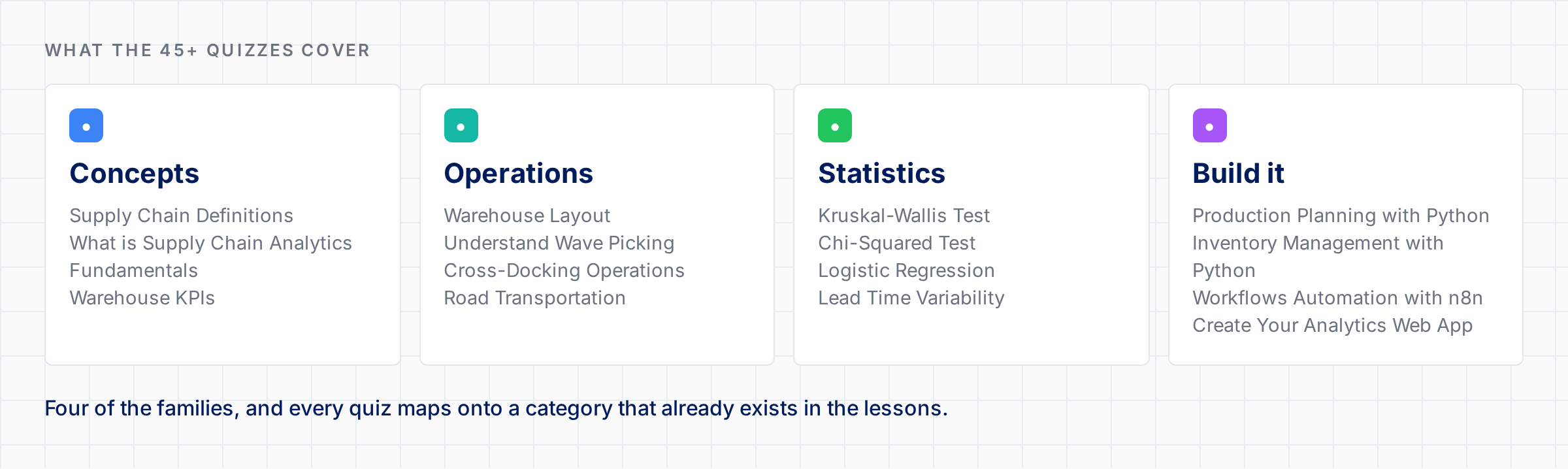
Once you know your level, the deep-dive quizzes let you attack one domain at a time, and there are more than 950 questions across 45+ of them.
Some are conceptual, such as Supply Chain Definitions or What is Supply Chain Analytics, and are the right place to start if the vocabulary is new.
Others follow a single case study end to end, such as Warehouse Layout, Understand Wave Picking, Road Transportation and Supply Chain Control Tower.
A third group is statistical, covering the Kruskal-Wallis test, the Chi-Squared test and logistic regression, which are the tests I use when somebody claims a process change worked.
Certification preparation, at three levels each
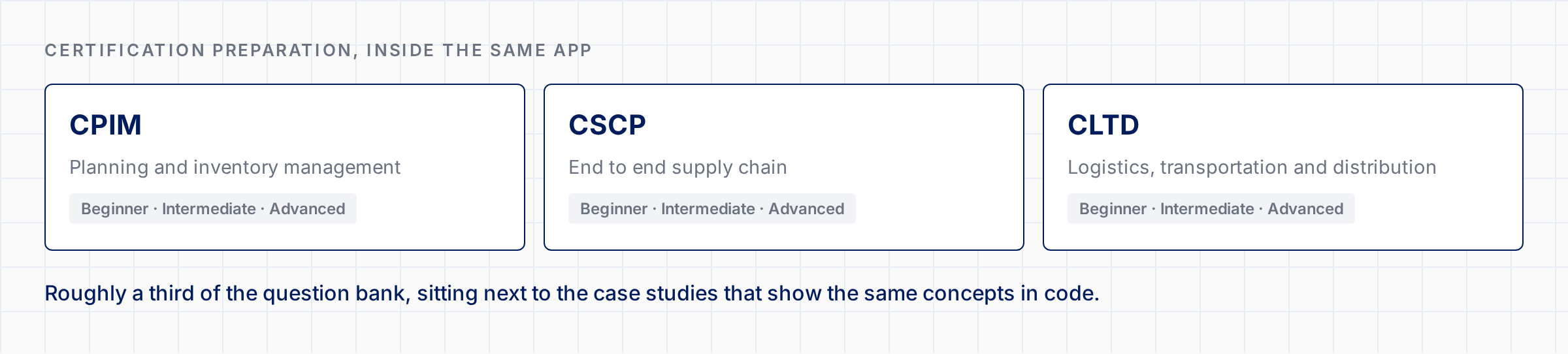
The newest addition is a set of quizzes preparing the three APICS certifications, with a Beginner, Intermediate and Advanced level for CPIM, CSCP and CLTD.
Together they account for roughly a third of the question bank, and they sit in the same app as the lessons rather than in a separate product.
That matters more than it sounds, because a certification question about safety stock and the lesson that computes it are the same subject seen from two sides.
The lessons, and the source code behind every one of them
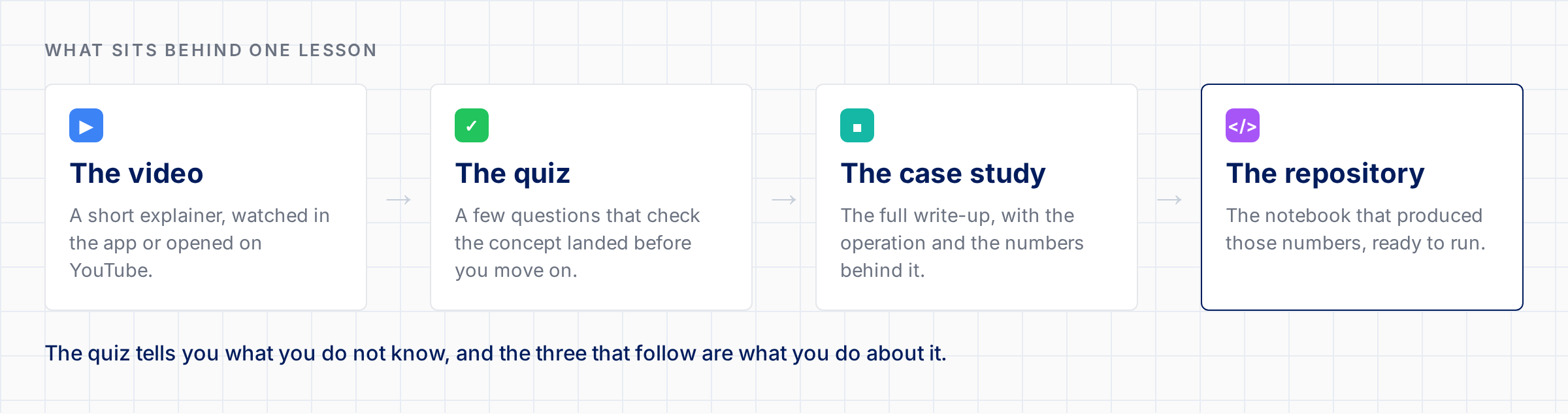
The quizzes tell you what you do not know, and the lessons are what you do about it.
They are organised into more than 20 categories, including Warehouse Layout, Inventory Management, Transportation Management, Production Planning, Lean Six Sigma and Agentic AI.
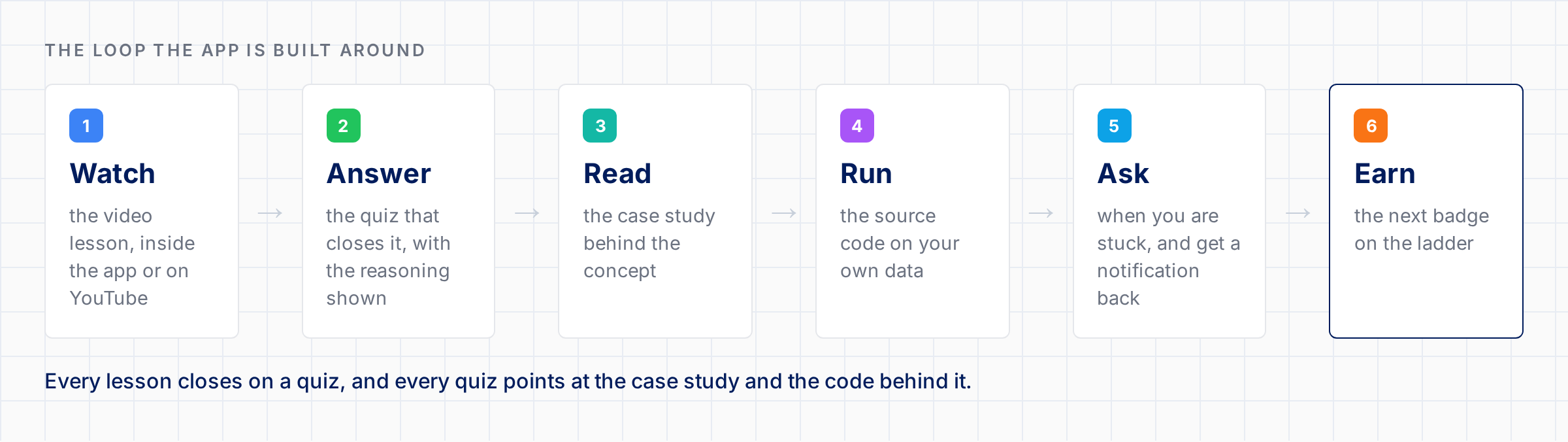
Each lesson is a short video you can watch inside the app or open on YouTube, followed by a quiz that checks the concept landed before you move on.
Watch the lesson, pass the quiz, read the case study, then run the code on your own data.
That last step is what makes this different from a course, because almost every lesson carries the full case study behind it, and almost every case study carries the repository with the source code.
If the lesson is about warehouse productivity, the case study is the picking route optimisation I ran on a real distribution centre, and the repository has the notebook that produced the numbers.
If it is about performance management, the case study is the OTIF reporting pipeline, and the same rule applies.
There are also downloadable resources in the app, including four ebooks covering supply chain analytics, Python automation, n8n AI automation and analytics for sustainability.
From Supply Beginner to Supply Scientist
My brother had the idea to gamify the experience, and I resisted it for about a week before admitting he was right.
Every quiz you finish earns points, and the points move you up a ladder of ten badges.
The ten levels
You start as a Supply Beginner after your first quiz above half marks, then move through Supply Learner, Picking Operator, Reach Truck Driver, Team Leader, Process Engineer, Warehouse Manager and Director.
The last two are the ones people notice, because CEO sits near the top and Supply Scientist sits above it.
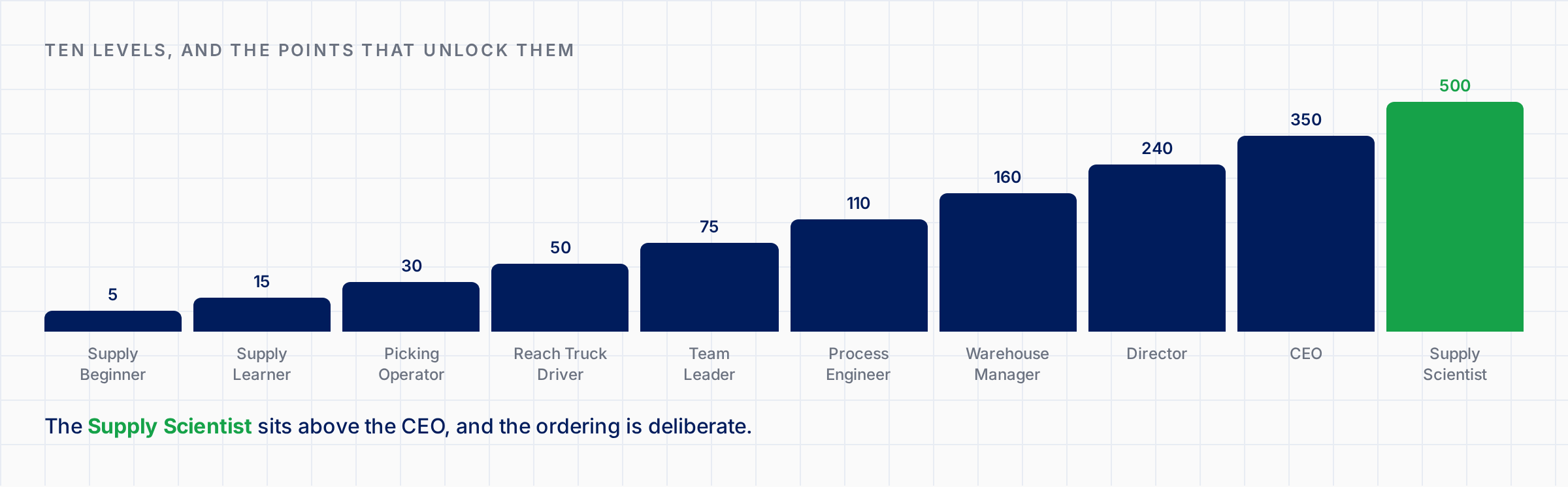
The Supply Scientist is above the CEO, and that ordering is deliberate.
The ladder is not a joke about hierarchy, it is a statement about how much of the value chain you have to understand before the analytics are worth anything.
Reaching the top means you have covered the chain from raw material procurement to last-mile distribution, which is roughly the point where you can build a portfolio that gets you interviews or start freelancing.
Your history is kept on your profile, so you can see which categories you keep failing, which is usually more informative than the badge itself.
Ask me a question, from inside the article you were reading
The last feature is the one I use most, and it exists because my inbox was failing everybody including me.
Questions arrive on LinkedIn, on X, in YouTube comments and in GitHub issues, and I do not check those four places with anything like the same frequency.
In the app there is a single question form, and everything sent through it lands directly on my Discord, where I answer it.
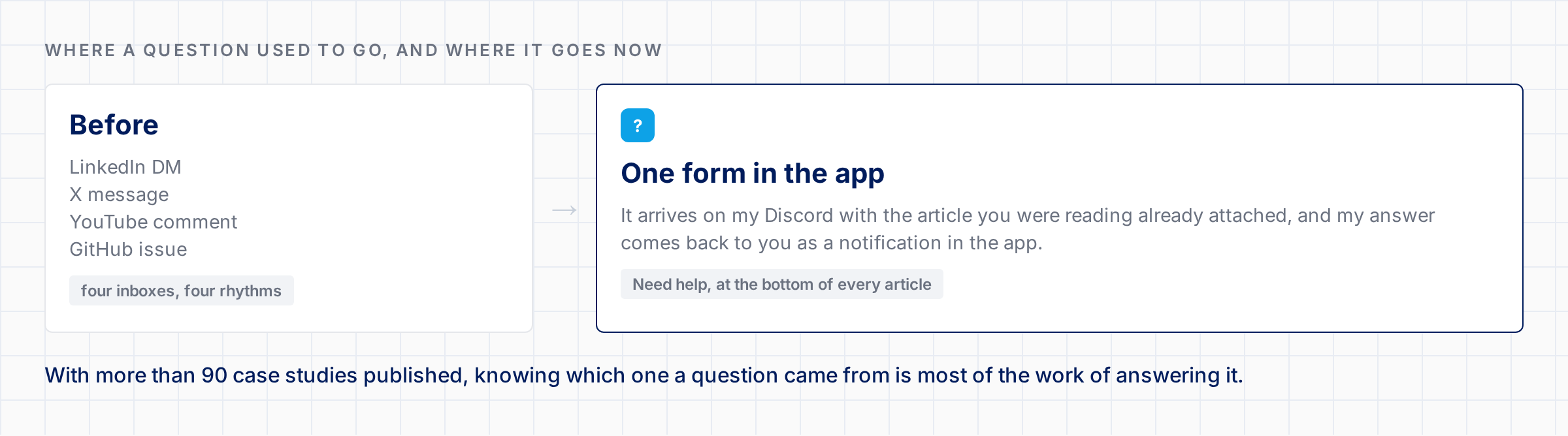
When I reply you get a notification in the app, which means the answer reaches you rather than sitting in a comment thread you never revisit.
There is a second half to this that I like even more.
At the bottom of the articles on this blog there is a Need help button, and clicking it sends you into the app with that specific article already attached to your question.
With more than 90 case studies published, knowing which one a question came from is most of the work of answering it well.
Conclusion
The app is not a course and it is not trying to replace the blog, it is the shelving and the librarian that the catalogue never had.
What we covered in this article
More than 950 questions across 45+ quizzes, sorted into four career tracks and a certification track covering CPIM, CSCP and CLTD.
Video lessons in more than 20 categories, each closed by a quiz and each linked to the case study and the source code behind it.
A ten-level badge ladder that ends above the CEO, and a question feature that reaches me directly with the article attached.
What comes next
My brother is building a supply chain optimisation game where you choose factory locations to minimise cost and CO2 emissions, and it is still work in progress.
If you find it and it behaves oddly, that is why.
I am also adding questions as the blog grows, which means the quiz bank follows the case studies rather than the other way round.
Try it
Go to supply-science.com, answer five questions, and see where you land.
It works on a desktop and on a phone, it costs nothing, and you can sign in with Google or LinkedIn if you want your progress kept.
Where to go next
- Why Supply Chain is the Best Domain for Data Scientists in 2026 (And How to Learn It): My take after 10 years in Supply Chain on why this can be an excellent playground for data scientists who want to see their skills valued.
- Find your Dream Job in Supply Chain Analytics - Create your Portfolio!: A practical guide for aspiring supply chain data scientists to create real-world projects using case studies shared here.
- What is Supply Chain Analytics?: Use data analytics with python to improve operational efficiency by enabling data-driven diagnostics and decisions at strategic and
Related videos
About Me
Let's connect on LinkedIn and Twitter. I am a Supply Chain Engineer who is using data analytics to improve logistics operations and reduce costs.