
Supply Chain Strategy: How to Turn One Sentence From the Owner Into a Model
A method for supply chain strategy that starts from what the owner says, finds the parameters inside it, connects them into one loop, replicates the business, then runs the scenarios.
Supply chain strategy is the set of decisions that shape an operation for years: which suppliers, which freight mode, how much stock to carry, which customers to serve and on what terms.
Every one of those decisions has already been made in any business that exists, usually by habit, and usually described by the owner as a fact of life rather than a choice.
That is the difficulty of strategy work, because the person who hires you does not hand you a decision to optimise, they hand you a complaint.
We do not have enough money to order more products.
That sentence came from a friend who runs an importing business, and it is accurate, and there is nothing you can do with it, because there is no variable in it and nothing you could put into a model.
In this article, I will go through the method I use to turn a sentence like that into a supply chain strategy.
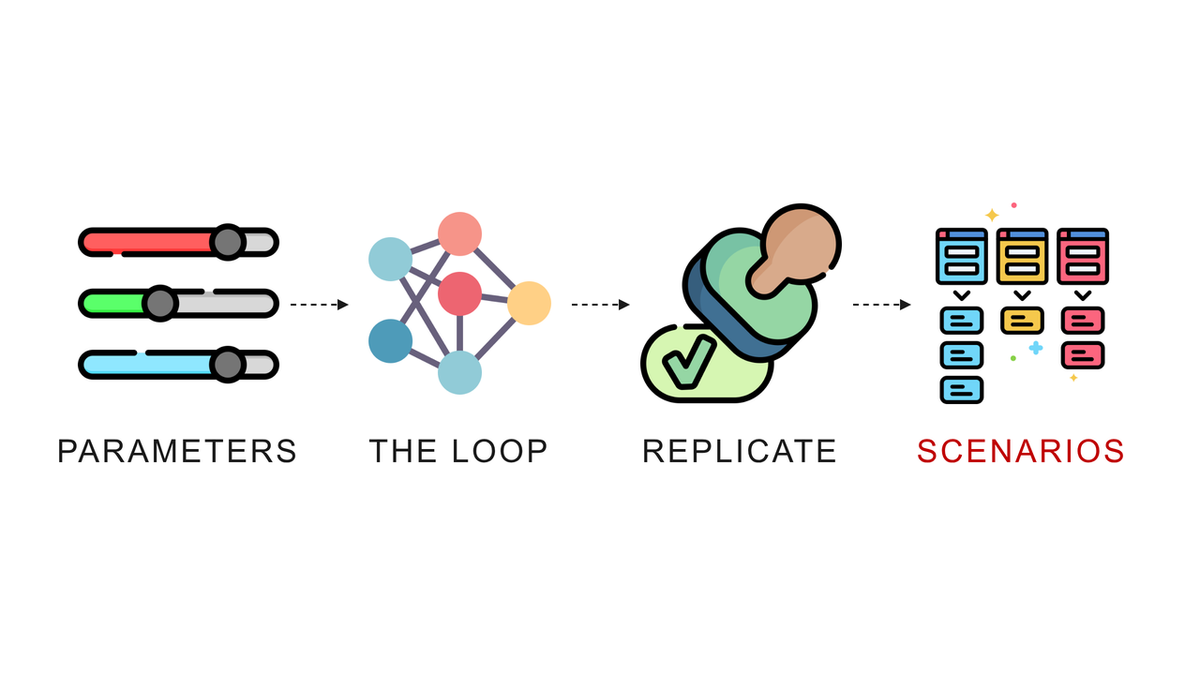
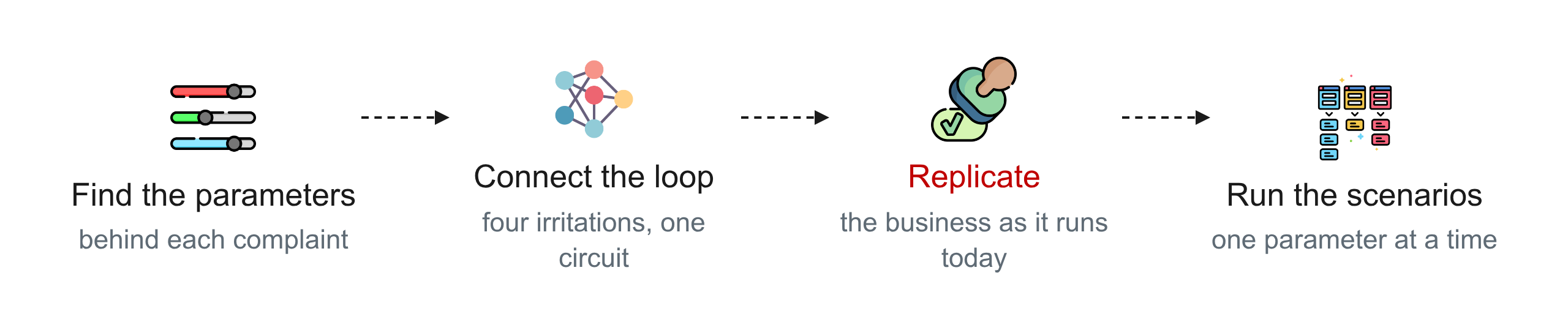
Find the parameters, connect them into a loop, replicate the business before you improve it, and then run the scenarios.
The scenario: an importer of reusable cups
Take a small business importing reusable cups and straws from a supplier in China, storing them near Paris, and selling to coffee shops directly and to distributors.
The owner checks the stock and orders when it gets low, enough to cover about eight weeks, which is a continuous review policy whether he calls it that or not, and the goods come by sea in four weeks.
Coffee shops pay immediately but a sales representative takes a 30% commission, and distributors take no commission and order more, but pay four weeks after delivery.
When asked what was holding the business back, the answer took one sentence, about cash, and the whole strategy was hiding behind it.
Step 1: find the parameter behind each sentence
A business owner describes their operation in the language of consequences, because consequences are what they experience: not enough cash, losing margin on direct sales, waiting too long for deliveries.
Every one of those is downstream of a decision they are making, usually without noticing that it is a decision at all.
Your job in the first week is to find, behind each complaint, the parameter that somebody actually chose, and to build nothing at all.
Here is what the sentences turned into, once we had reconstructed how the business actually runs.
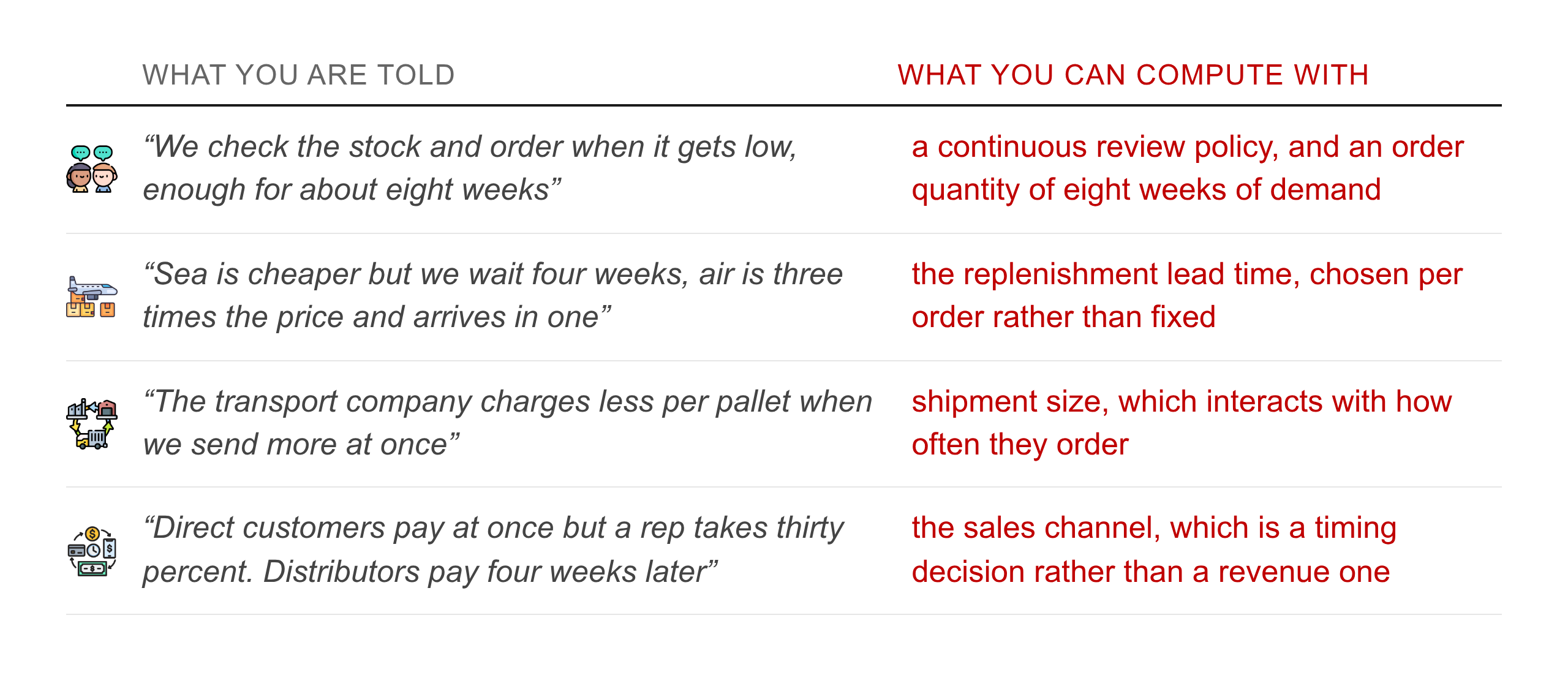
"We order when it gets low, enough for about eight weeks." That is a continuous review policy with an order quantity of eight weeks of demand, and eight is a parameter.
"Sea freight is cheaper but we wait four weeks, air is three times the price but arrives in one." That is the replenishment lead time, and it is a lever, not a fact.
"The transport company charges less per pallet when we send more at once." That is the shipment size, it interacts with how often they order, and container loading is where it is optimised.
"Direct customers pay immediately but the rep takes thirty percent, distributors pay four weeks late." That is the sales channel mix, and it decides when the money comes back.
None of those four was presented as a decision, and all four were described as facts of life, which is exactly what a parameter looks like from the inside of a business.
Step 2: connect the parameters into one loop
Once the sentences are translated, something useful happens: the parameters turn out to be connected.
The freight mode sets the lead time, and the lead time sets how much stock the ordering rule has to cover.
The order size affects the shipping cost per unit, and the sales channel decides when the money comes back, which decides whether you can afford the next order.
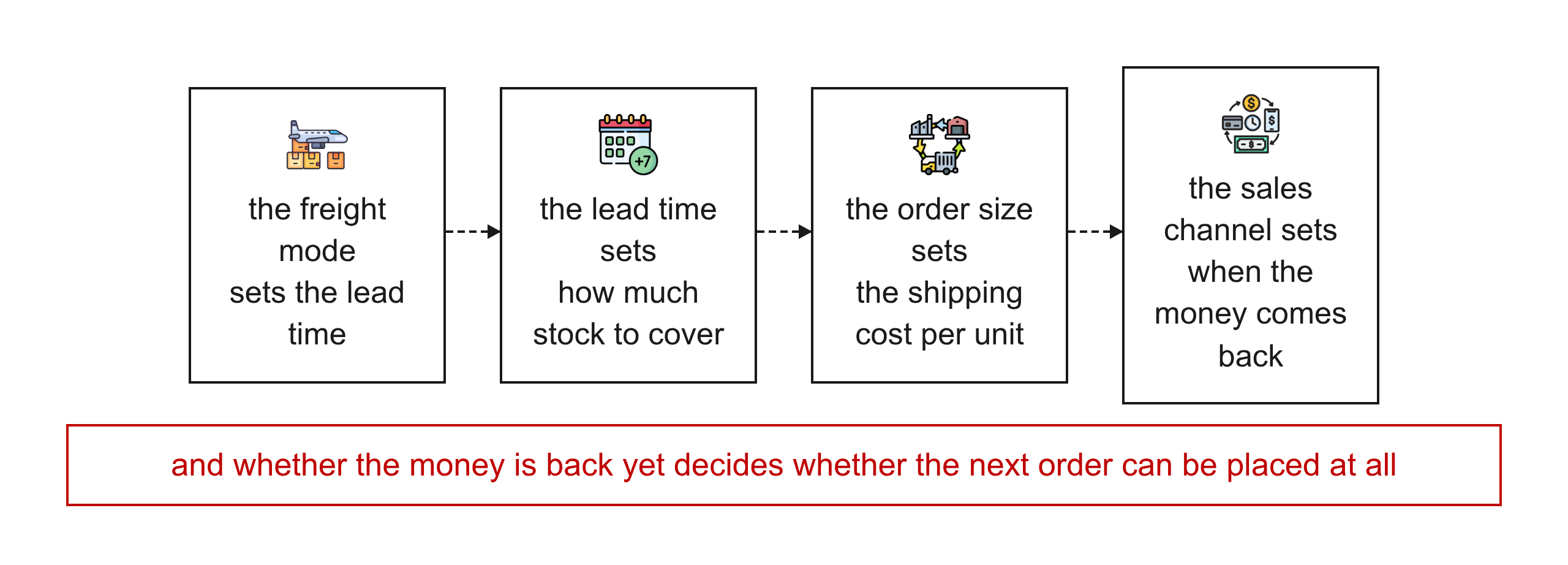
The owner experiences four separate irritations. The model shows one loop, and the loop is why solving them one at a time had not worked.
That is the deliverable before any optimisation: a picture of their own business as a connected system, which they have never seen because they live inside it.
Step 3: replicate before you improve
There is one discipline here that I would not skip, and it is tempting to skip it because it produces no new insight.
Build the model to reproduce what they currently do, first, and check that the output matches their reality.
If the model says they should be running out of cash in week three and they are, you have something they will believe; if it says something they know to be untrue, you have found a parameter you translated wrongly.
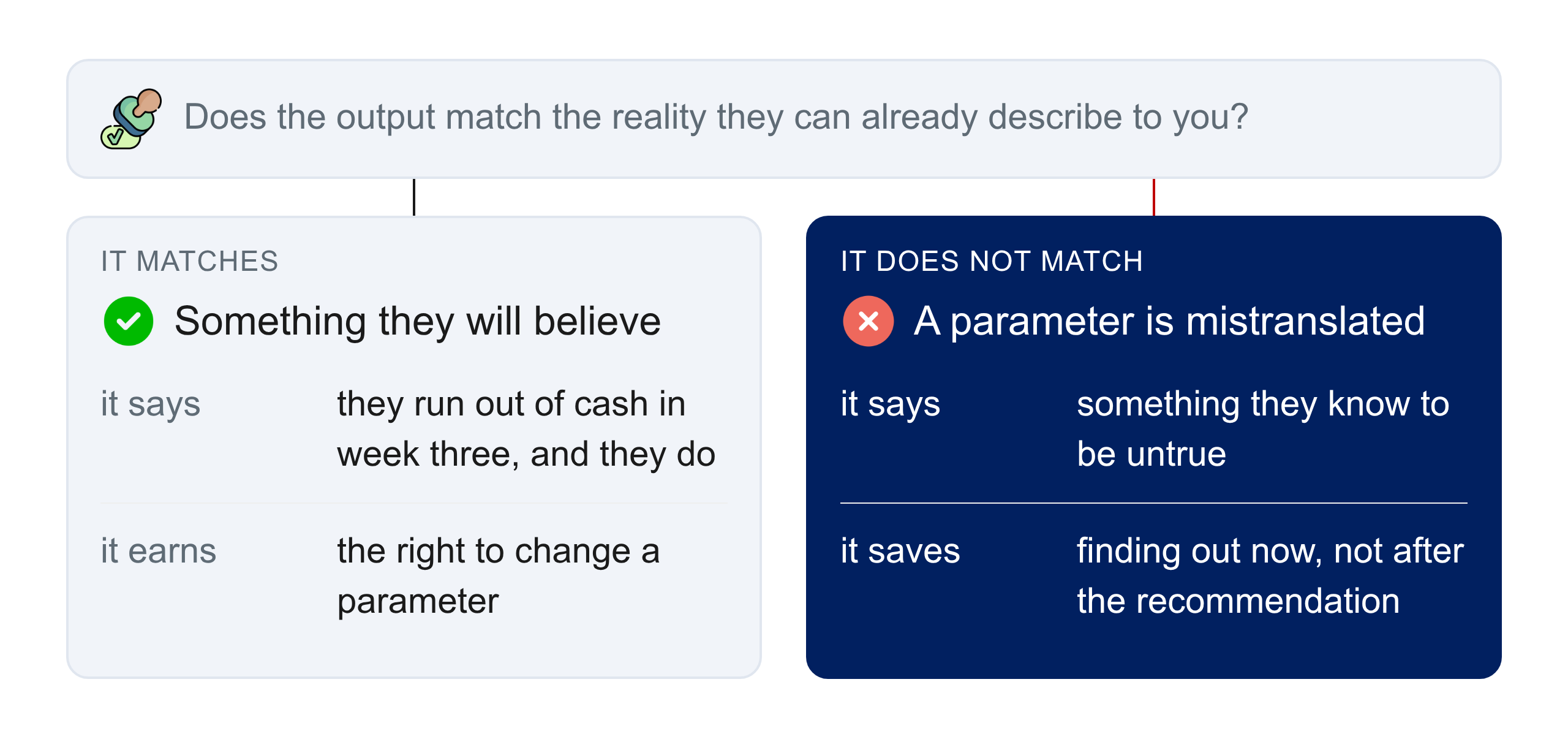
The first version of the model exists to be checked against the client's own experience, not to be better than it.
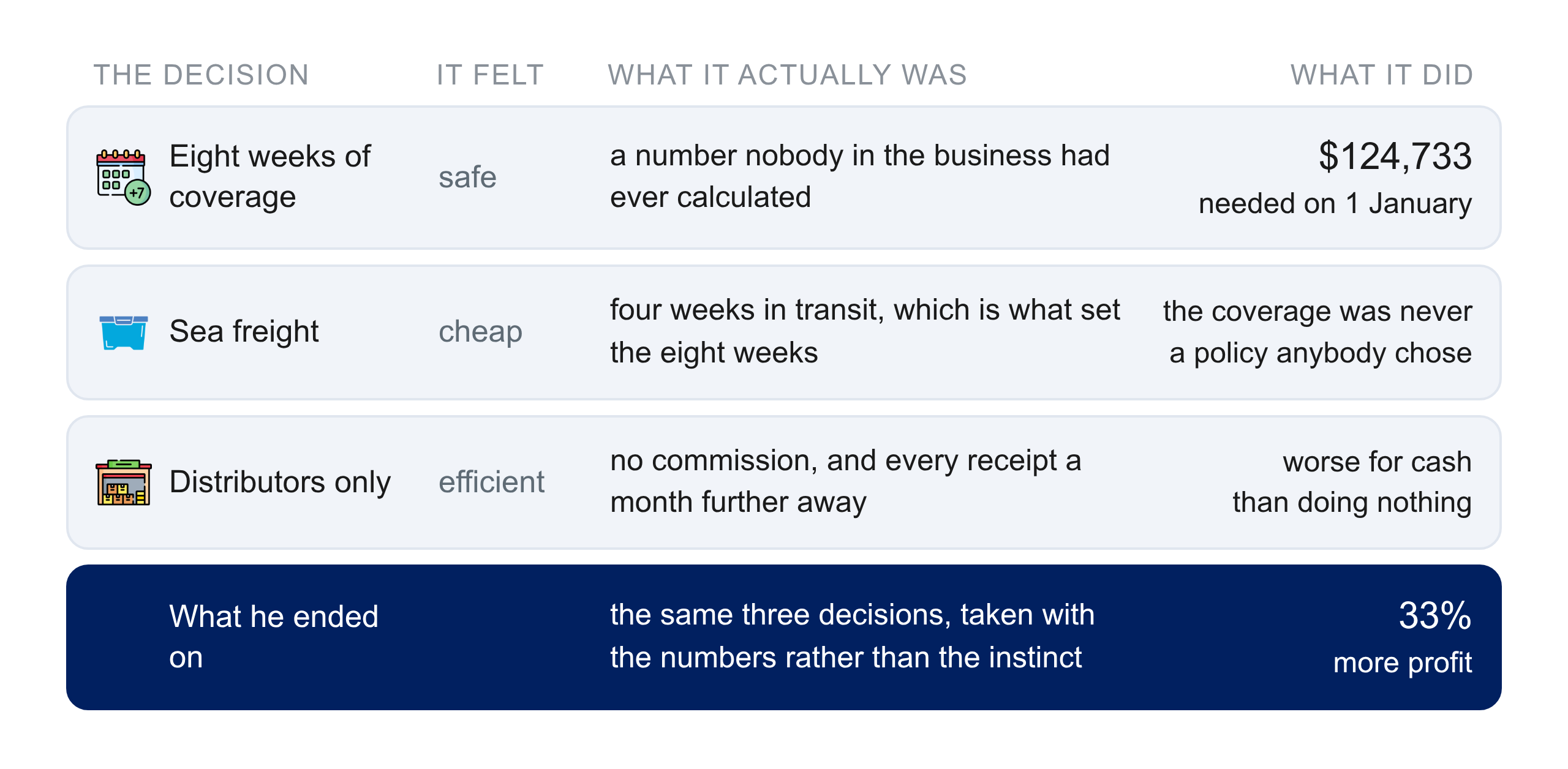
For this business the replicated model said that with eight weeks of coverage by sea, the owner needed $124,733 in the bank on the first of January just to survive his own sales.
His cash went negative in week three, which matched what he was living.
Step 4: run the scenarios
Only after the replication does it make sense to change a parameter and see what happens, and the business planning case study works through three.
Order less. Dropping from eight weeks of coverage to six cut the cash needed to $74,733, a 41% reduction, and that is where most people stop.
Change the freight mode. Air freight at three times the sea rate cut the lead time from four weeks to one, which let him hold three weeks of stock instead of eight, and the cash needed fell to $17,288, an 86% reduction, for a 12% drop in margin per pallet.
Change the channel. Selling only to distributors looked clever on paper, no commission and bigger orders, and it required $197,602 of cash, more than doing nothing, because every receipt moved a month further away.
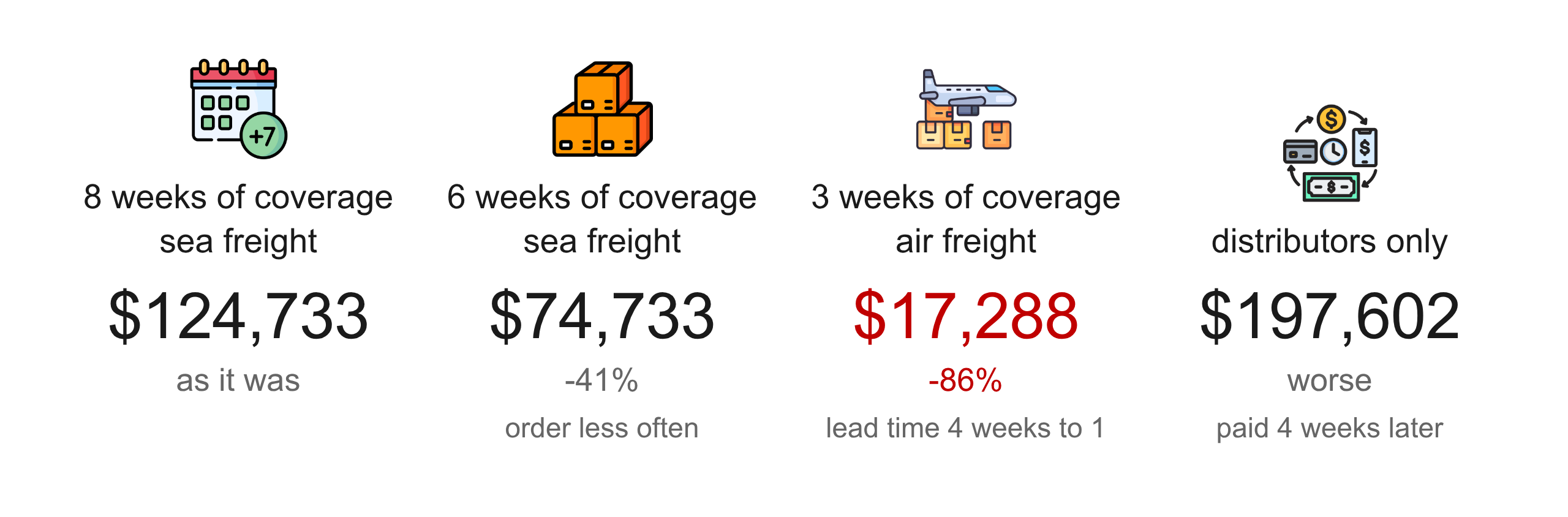
None of the three scenarios required a new customer, a loan or a better product, and the combination he ended on was worth about 33% more profit.
Every component of it was a decision he was already making, badly, by instinct: eight weeks felt safe, sea freight felt cheap, and distributors felt efficient.
The revenue optimisation follow-up extends the same model to a degressive freight tariff and a new business partner, because once the loop exists every new question is a parameter change.
Why this is strategy and not planning
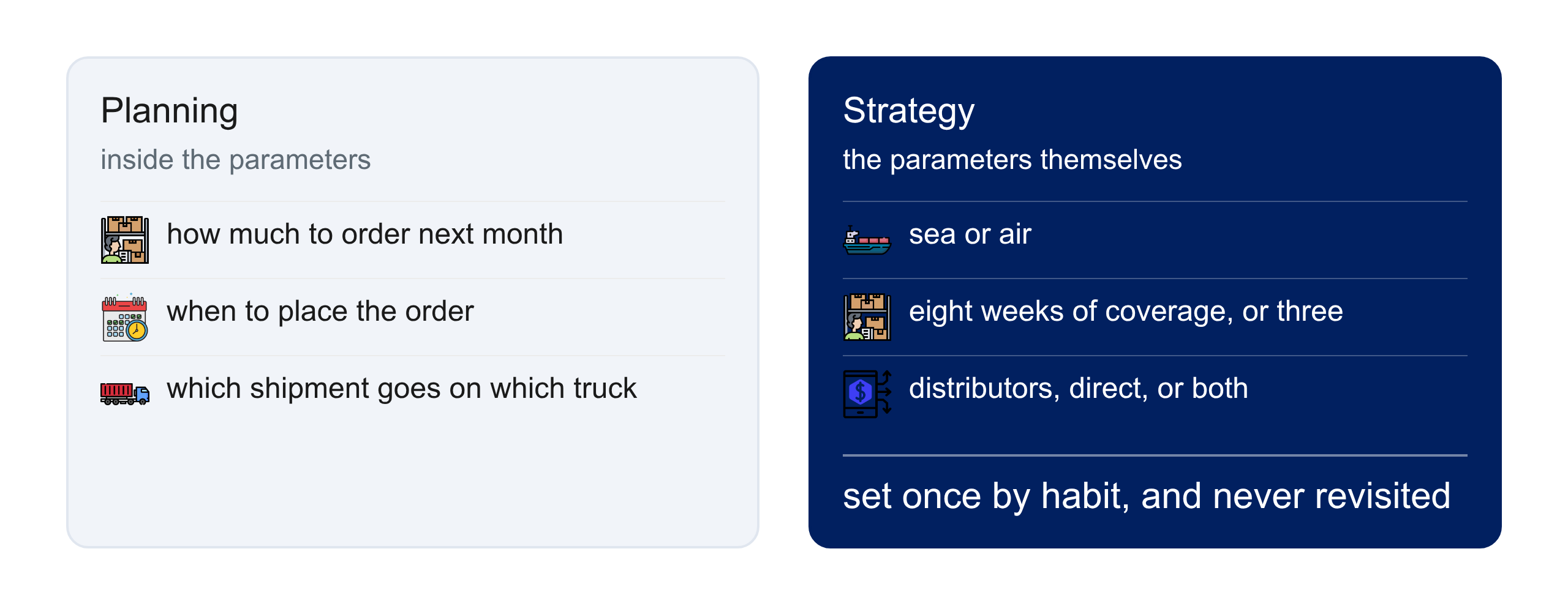
Planning decides how much to order next month inside the parameters; strategy decides the parameters.
The freight mode, the coverage rule, the channel mix and the supplier are the strategy, and the owner had set all four without a model, which is normal, and had never revisited them, which is expensive.
The same method scales from a cup importer to a manufacturer choosing where to build plants, which is linear programming for network design, and to a retailer deciding how sustainable its network can be before the cost moves.
Inventory is the finance position expressed in cardboard, and not a warehouse problem finance hears about later.
The method in one hour
I recorded the full case, the interviews, the value chain reconstruction, the model, and the scenarios it made possible.
What you need before you start: one business owner willing to talk for an hour, and the discipline not to open a notebook during it.
Conclusion
Supply chain strategy starts from a sentence, and the work is finding the parameters inside it, connecting them, replicating the business as it is, and only then asking what would happen if one of them moved.
What we covered in this article
The four sentences and the four parameters behind them, the loop that connects them, the replication step that earns the owner's trust, and three scenarios that took the cash needed from $124,733 to $17,288 without a new customer.
Where to go next
The inventory rules behind the coverage parameter are explained in supply chain planning, and if you would rather practise than read, the Supply Science App has a quiz on business planning with Python.
Related videos
The videos behind this article, already on the channel:
- How to Use Data for your Business Strategy?
- The Real Cost of Spreadsheet Planning (And How to Fix It)
- Supply Chain Optimization with Python (Source Code)
- Understand Sustainable Supply Chain Network Design
The ones coming next, with the date each goes public:
- What is Supply Chain Optimisation? A Practical Case Study, 28 September 2026
- How to Stress-Test a Supply Chain Network (Monte Carlo), 9 November 2026
- We Saved 200,000 Euros by Changing One Inventory Rule, 11 November 2026
- Graph Theory to Cut Retail Distribution Costs, 16 November 2026
About Me
Let's connect on LinkedIn and Twitter. I am a Supply Chain Engineer who is using data analytics to improve logistics operations and reduce costs.