I Simulated an International Supply Chain and Let OpenClaw Monitor It
Mario asked me why 18% of his shipments were late when every team hit their target. I built a live simulation, connected an AI agent, and let it investigate across 8 routes in Asia and the Middle East.
A few weeks ago, I published an article showing how an AI agent could help a fashion company analyse failures in its distribution chain.
The idea was to connect Claude Opus 4.6 to transportation data to explain late store deliveries.
This agent was able to investigate, by connecting to the shipment data, and find the root cause of specific failures.
Why was a Shanghai store delivered with a 45-hour delay when every team supposedly hit their target?
A week later, I received a message from a potential customer: Mario, a logistics director at a fashion company based in Milan.
"We have exactly this problem: when I ask the teams, everybody is on time, but 18% of our shipments arrive late. Can your AI agent monitor this in real time?"
They ship luxury goods from a Milan warehouse to 67 stores worldwide through a complex chain involving multiple teams that depend on one another to ensure orders are delivered on time.
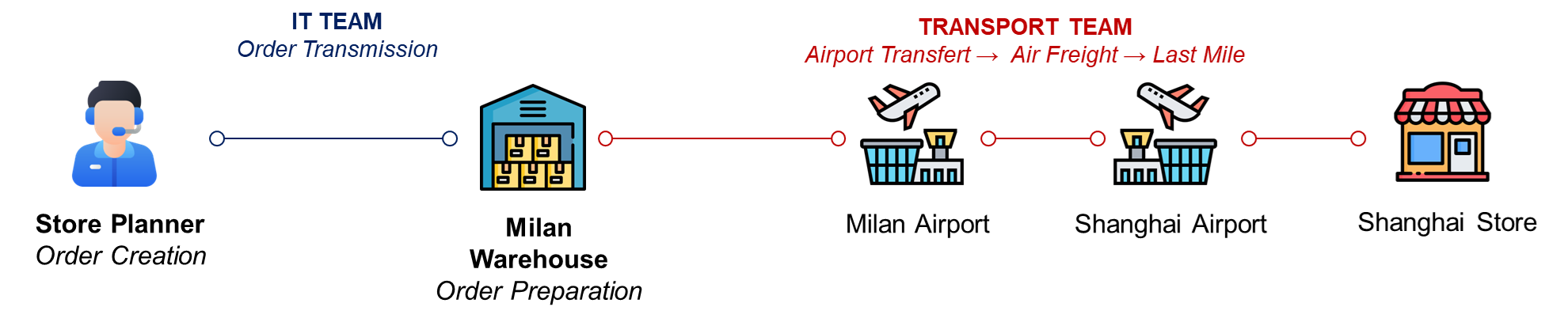
Mario: "My team is overwhelmed by the complaints from stores and cannot keep up with the analysis workload."
To convince Mario, I built a simulation of his entire distribution chain (including realistic delays) running 24/7 on a live server.
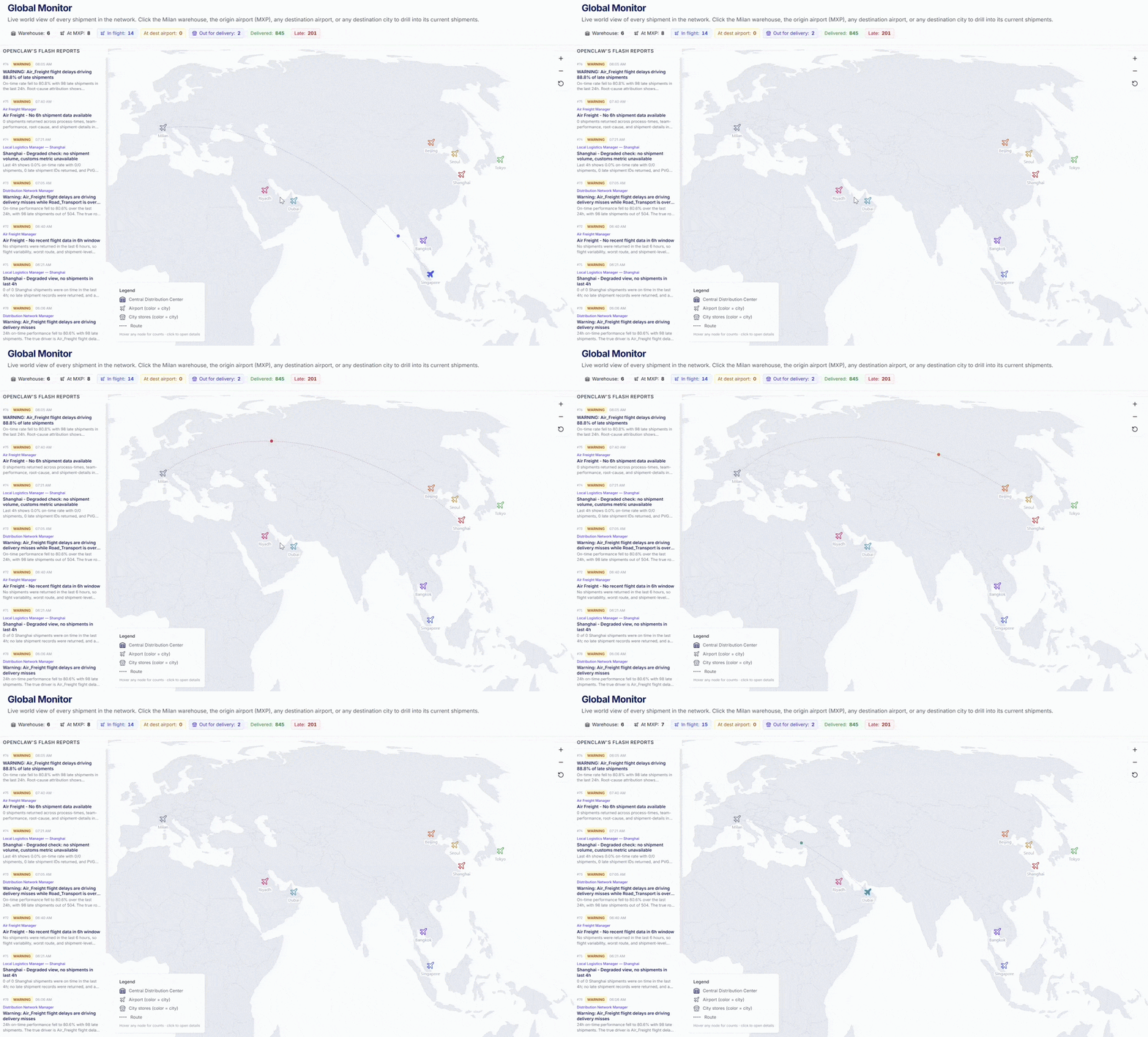
As Mario's team already uses OpenClaw for daily operations, I connected it to the simulation and created a team of analyst agents powered by Codex.

In this article, I will explain how these agents help Mario's analysts keep up with alerts and status updates and send them directly to operational teams via Telegram.
Together, they form a team of AI investigators running 24/7 on their behalf.
Mario's Challenge: Managing a Chain Where Every Team Depends on the Next
To share this solution publicly without using Mario's confidential data, I built a simulator that reproduces his entire distribution chain.
We have a similar network, including process variability and delays that lead to the same cascade patterns Mario faces, and it runs 24/7 on a live server.
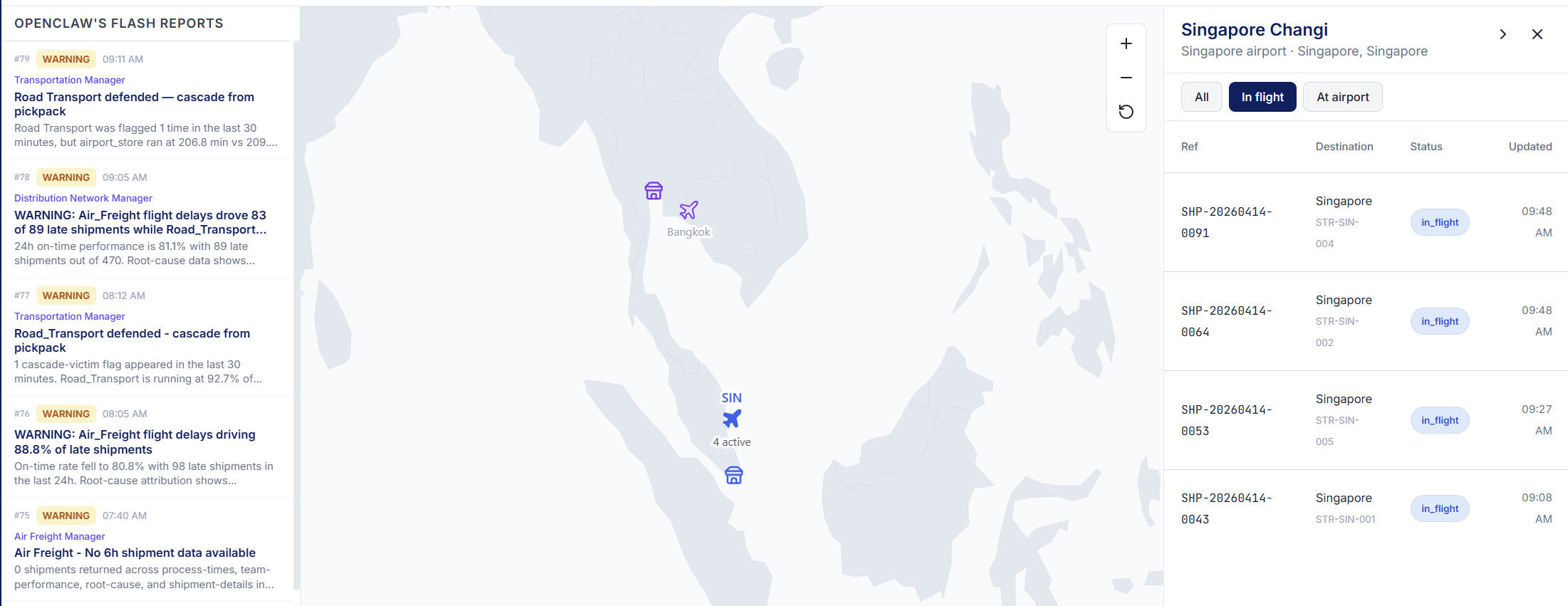
For example, I checked Tuesday morning; there were 4 shipments currently flying to Changi Airport in Singapore.
This living digital twin will be our playground to test OpenClaw's capabilities.
For a live demo,
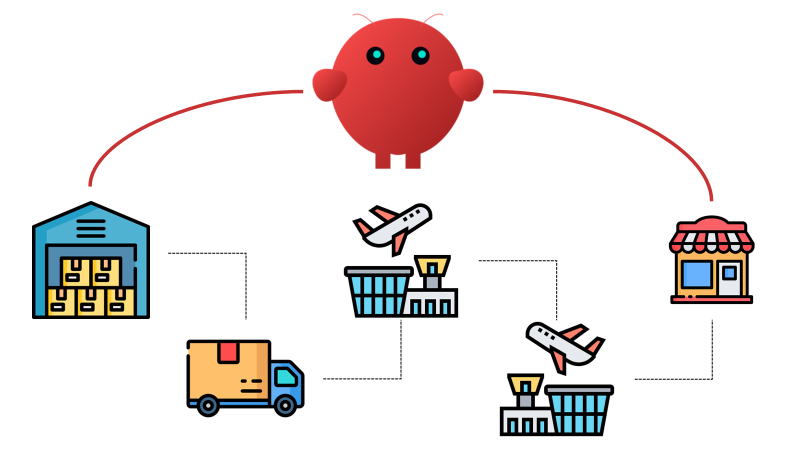
How luxury goods travel from Milan to Tokyo
Throughout the day, stores across Asia and the Middle East send replenishment orders to Mario's distribution centre on the outskirts of Milan.
Order XD-487: We need 10 bags of reference YYY delivered at Shanghai Store 451 by May 1st, 2026.
Each order follows the same journey through 8 steps owned by 4 different teams.
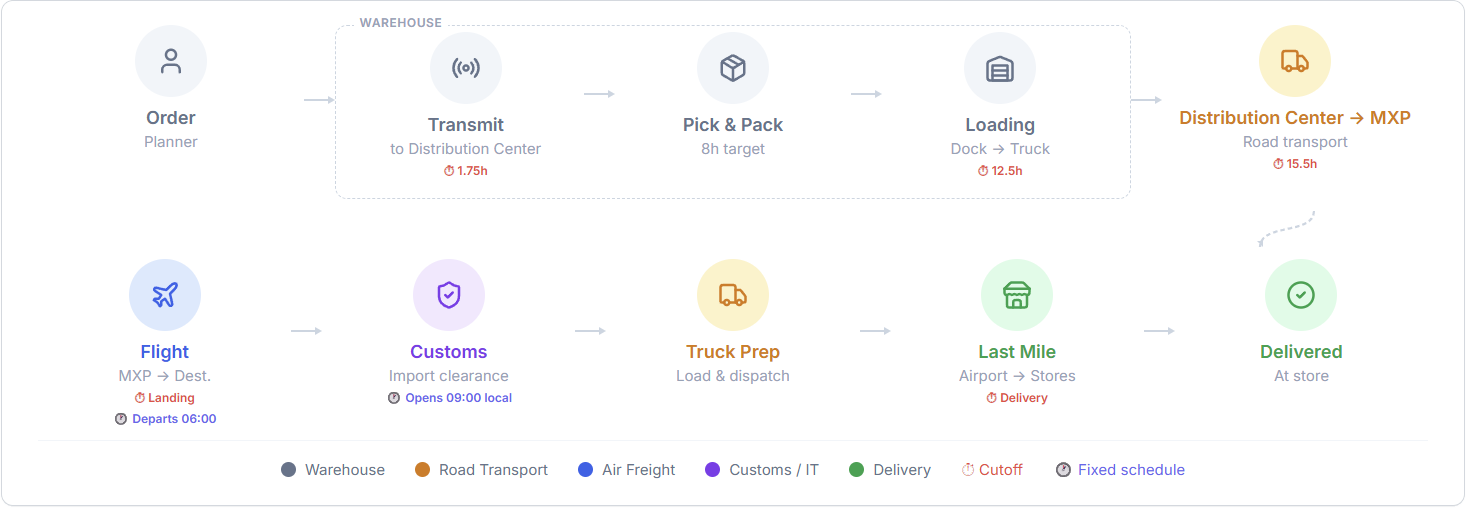
They need to respect fixed daily schedules (flight take off, customs clearance) that create bottlenecks nobody sees coming.
Because Shanghai stores shipments missed yesterday's flight, they will be delivered with 2 days delays.
Our simulator continuously generates 500+ orders per day with realistic variability at each step.
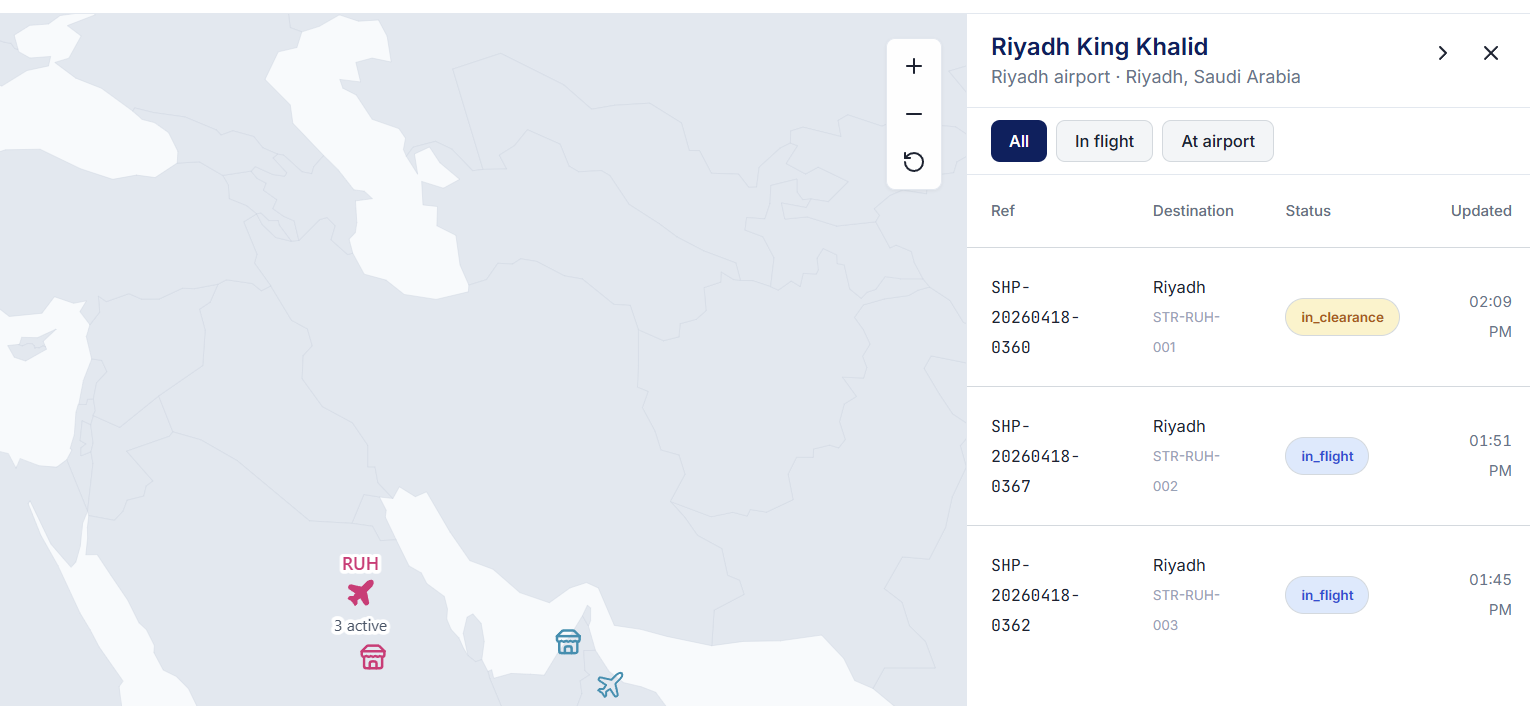
Some shipments flow smoothly. Others hit the cascading delays that make Mario's life difficult.
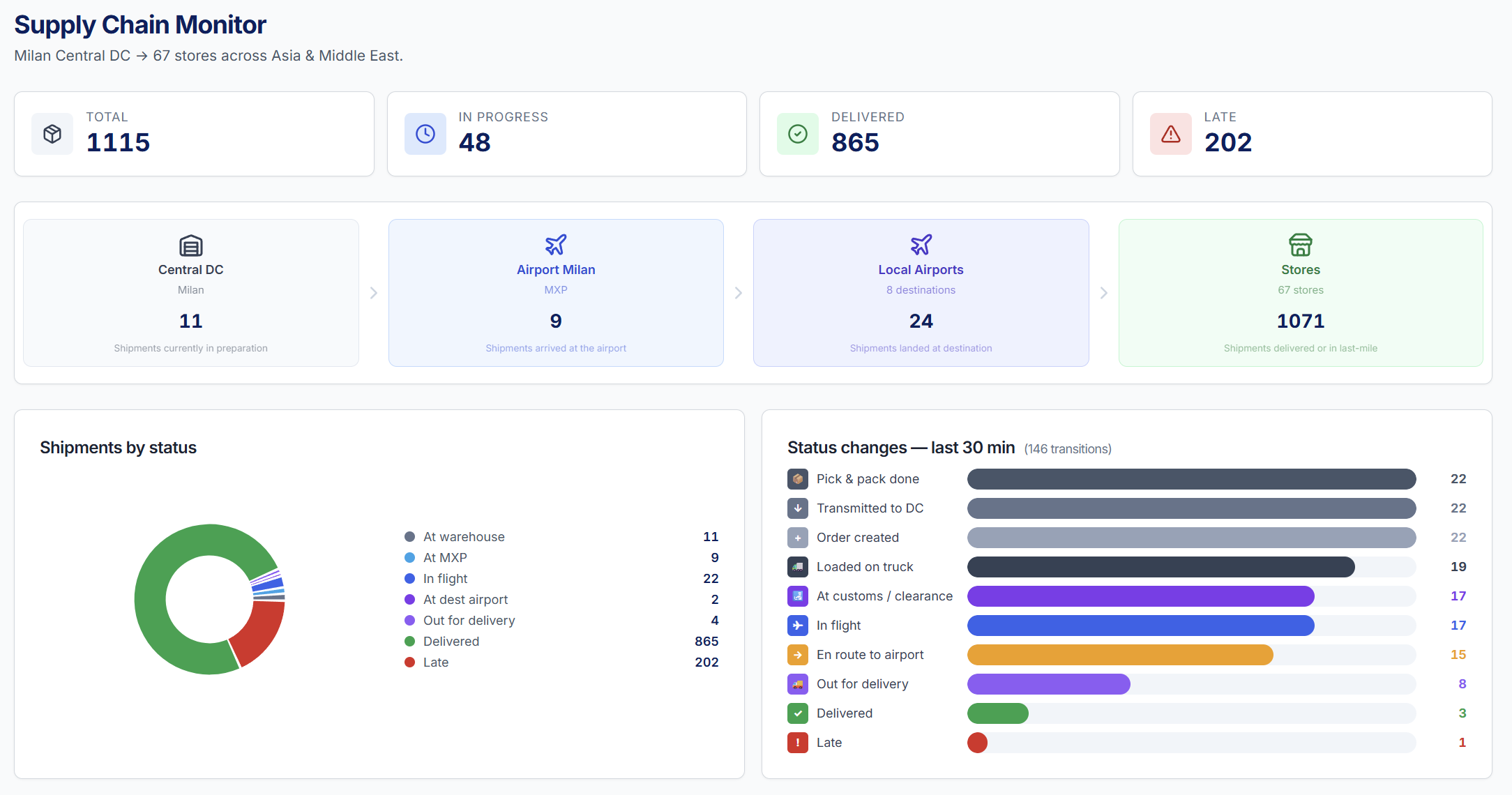
Why does Mario need support from agents?
Mario's Nightmare: A delay that nobody owns
Every Monday morning, store managers escalate the same complaint to Mario: shipments arriving days late, empty shelves for new collection launches, unhappy customers walking out.
For a brand that sells scarcity, being late means lost sales.
Therefore, Mario tries to find the root cause of these delays. But when he asks, every team defends itself.
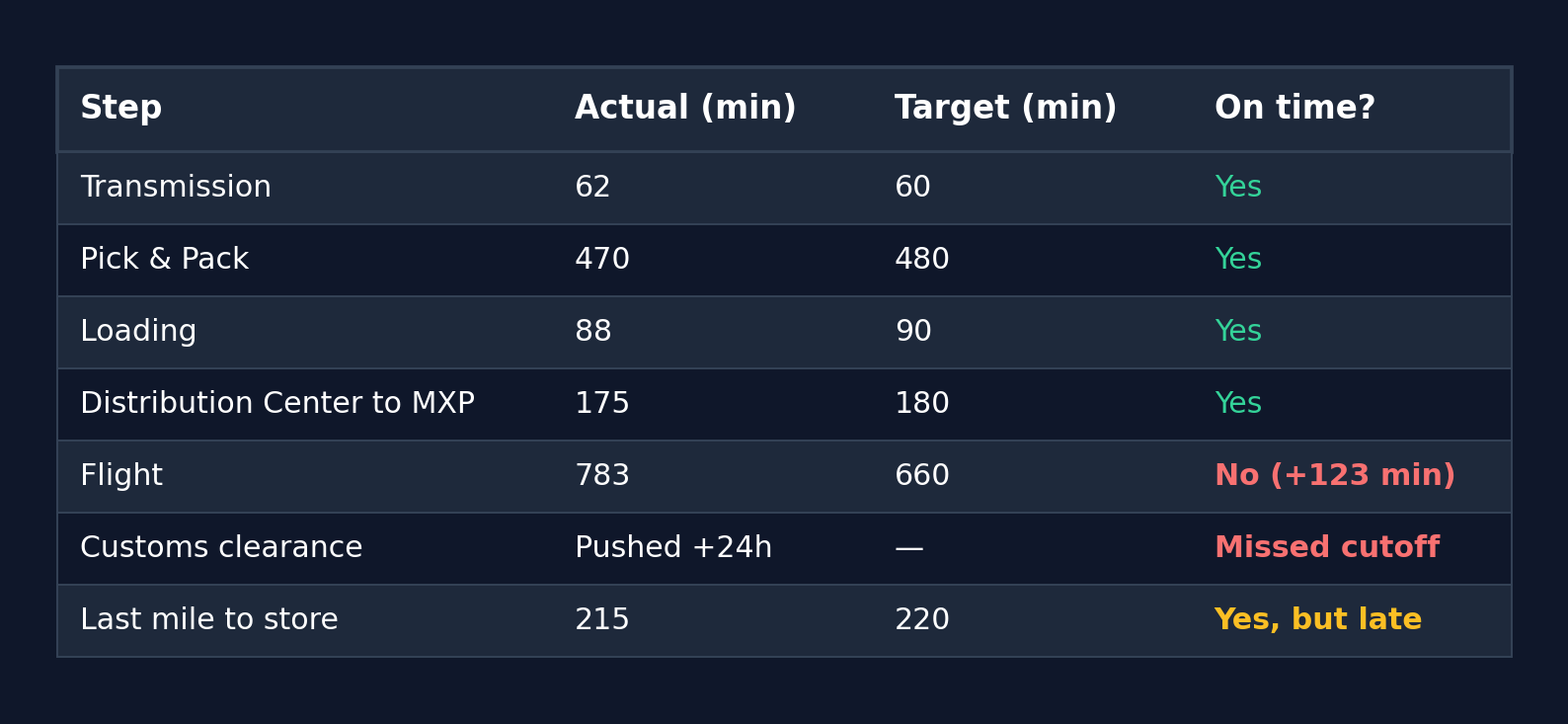
In the example above, everyone is on time, yet the shipment is late. Nobody owns the problem.
So Mario asks his analyst to dig through the data. But with 90 late deliveries every day across 8 cities, Excel and CSV exports are not enough. They can only review a few cases a week.
What Mario really needs is a team of agents that investigates every late shipment for him, around the clock.
Meet the AI Performance Managers
Openclaw manages a team of Agentic Analysts.
Each agent is connected to the system where every shipment, route, and delivery are tracked: Transportation Management System (TMS).
They run 24/7 and cover a specific scope of responsibility.
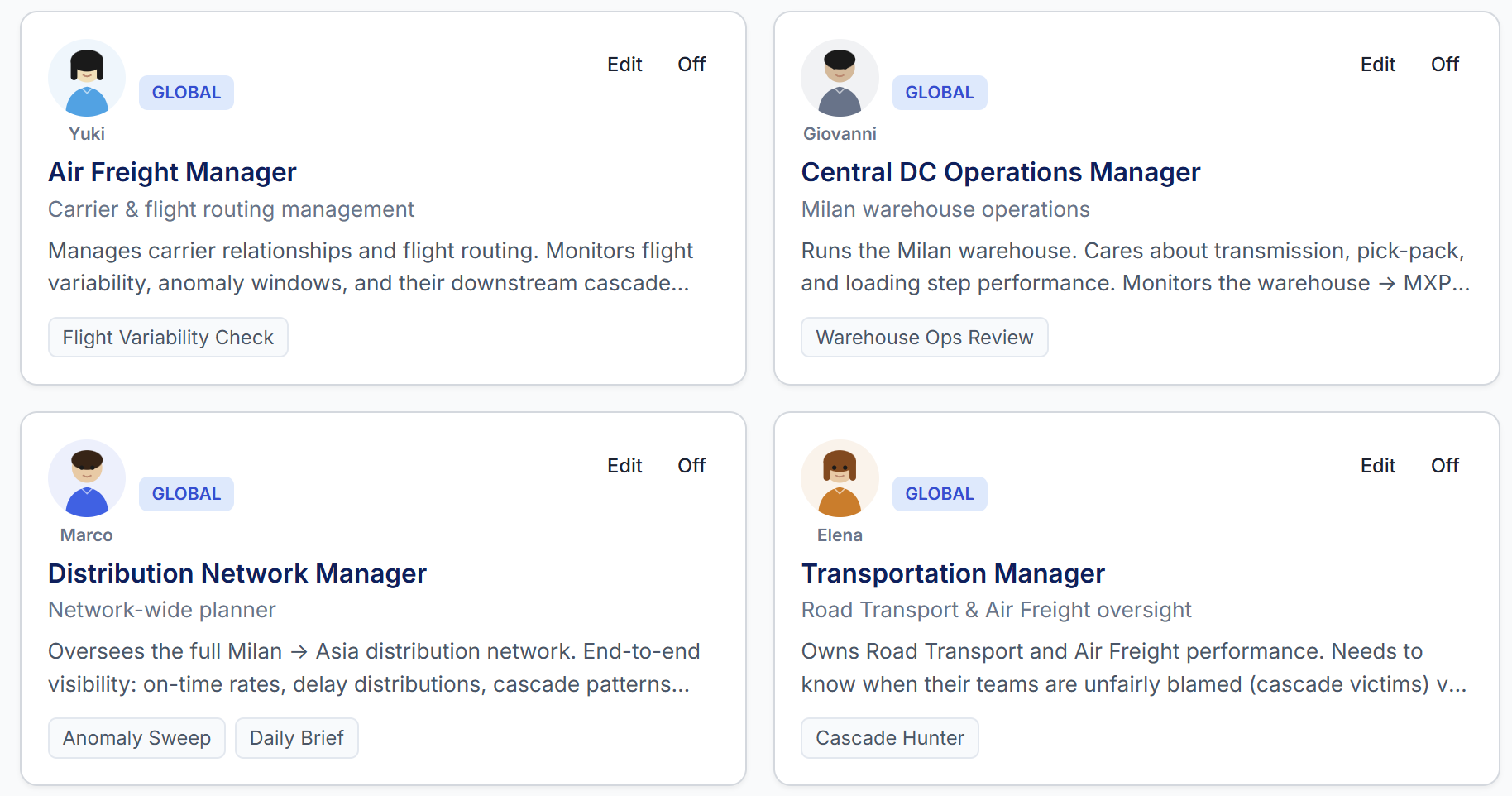
Four global personas watch the entire network:
- Marco, the Distribution Network Manager, runs the overall anomaly sweep and flags any city that is drifting.
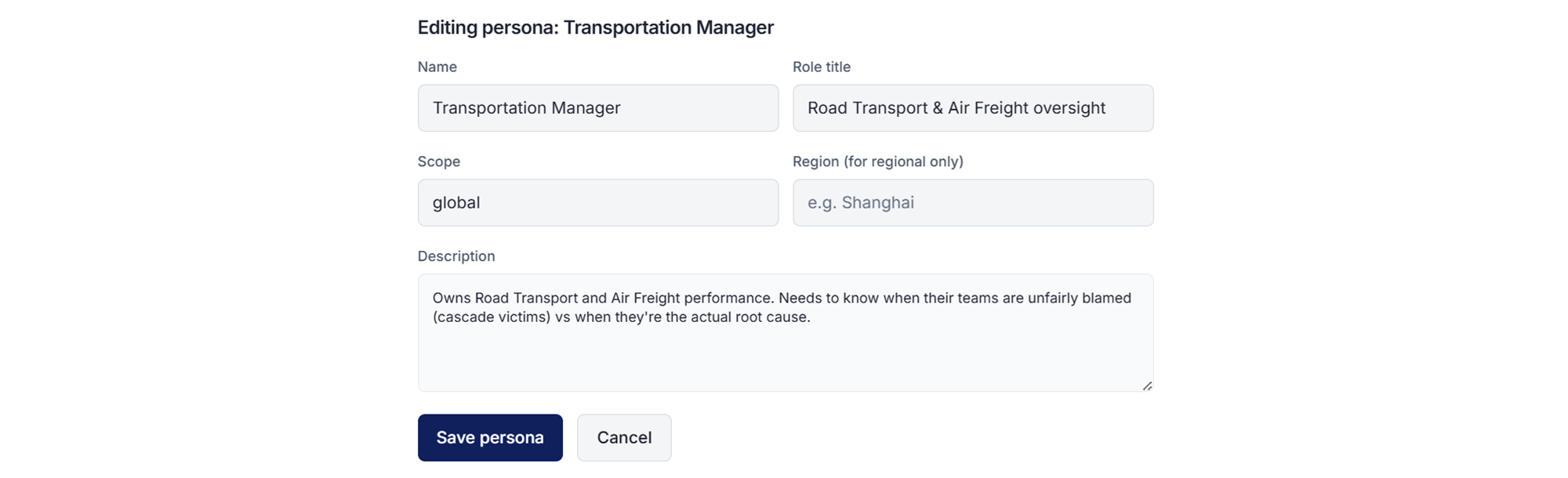
- Elena, the Transportation Manager, hunts for situations where a team blamed for a delay they did not cause.
- Giovanni, the Central DC Operations Manager, monitors warehouse throughput.
- Yuki, the Air Freight Manager, tracks flight variability and quantifies the downstream impact on late deliveries.
We need agents to monitor last-mile delivery and echo store complaints.
Eight regional personas each watch a single city in China, Japan, Saudi Arabia and the UAE.
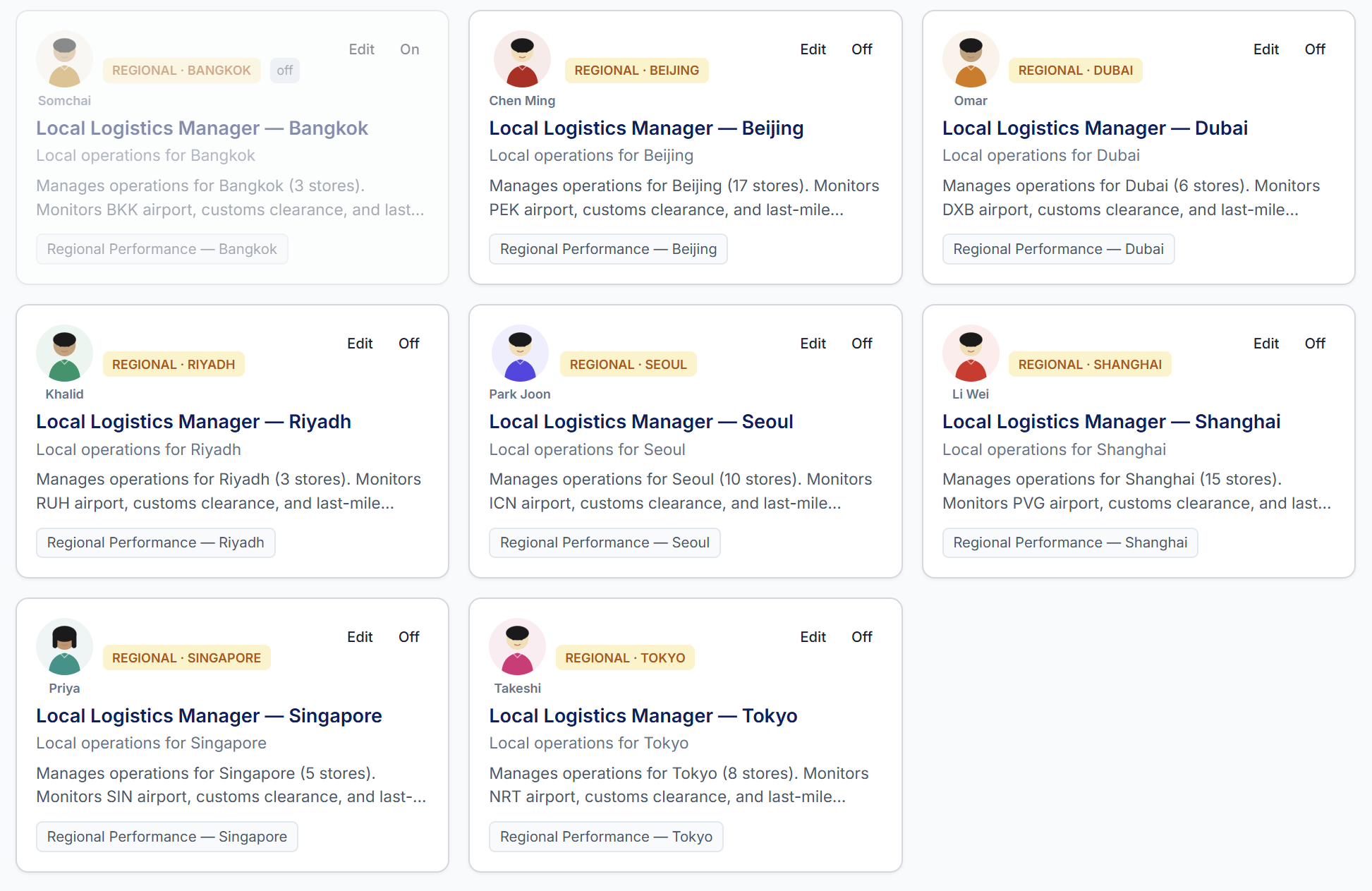
Every hour, each persona runs its own investigation:
- Pulls transactional data from the backend, analyses the performance of their scope and spots the failures.
- When something needs attention, the persona posts a flash report to the dashboard and sends a summary to the operational team on Telegram.
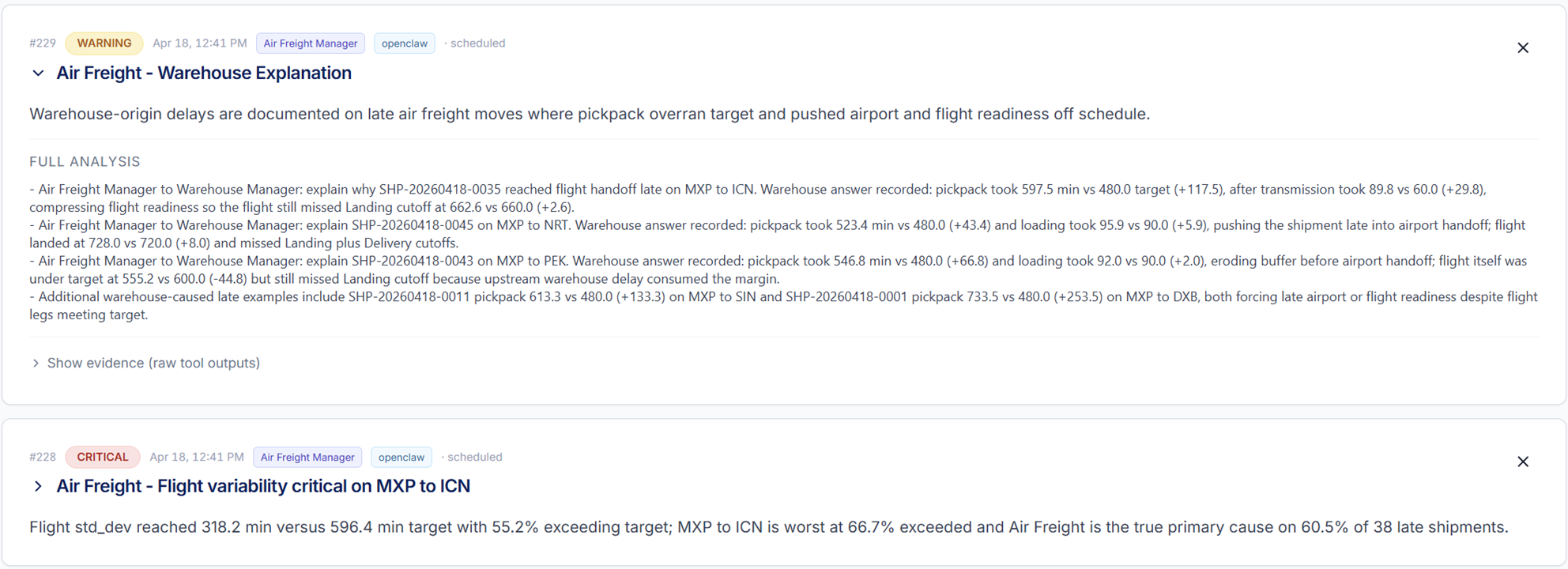
Each report has three parts that match how a human analyst would brief Mario:
- The headline, a one-line title identifying the issue (e.g. Air Freight - Warehouse Explanation)
- The summary, a single sentence with the finding (e.g. Pick & pack delays pushed several shipments past the flight readiness deadline)
- The full analysis, with specific shipment IDs, durations, and how much each step went over its target.
The idea is to provide only the information needed for the analyst to take action.
For that, each prompt is editable in the admin panel, so the operational team can adjust what Elena looks for or how Li Wei formats his Shanghai briefings without writing a single line of code.
With this team of AI agents running around the clock, Mario no longer walks into his Monday meeting empty-handed.
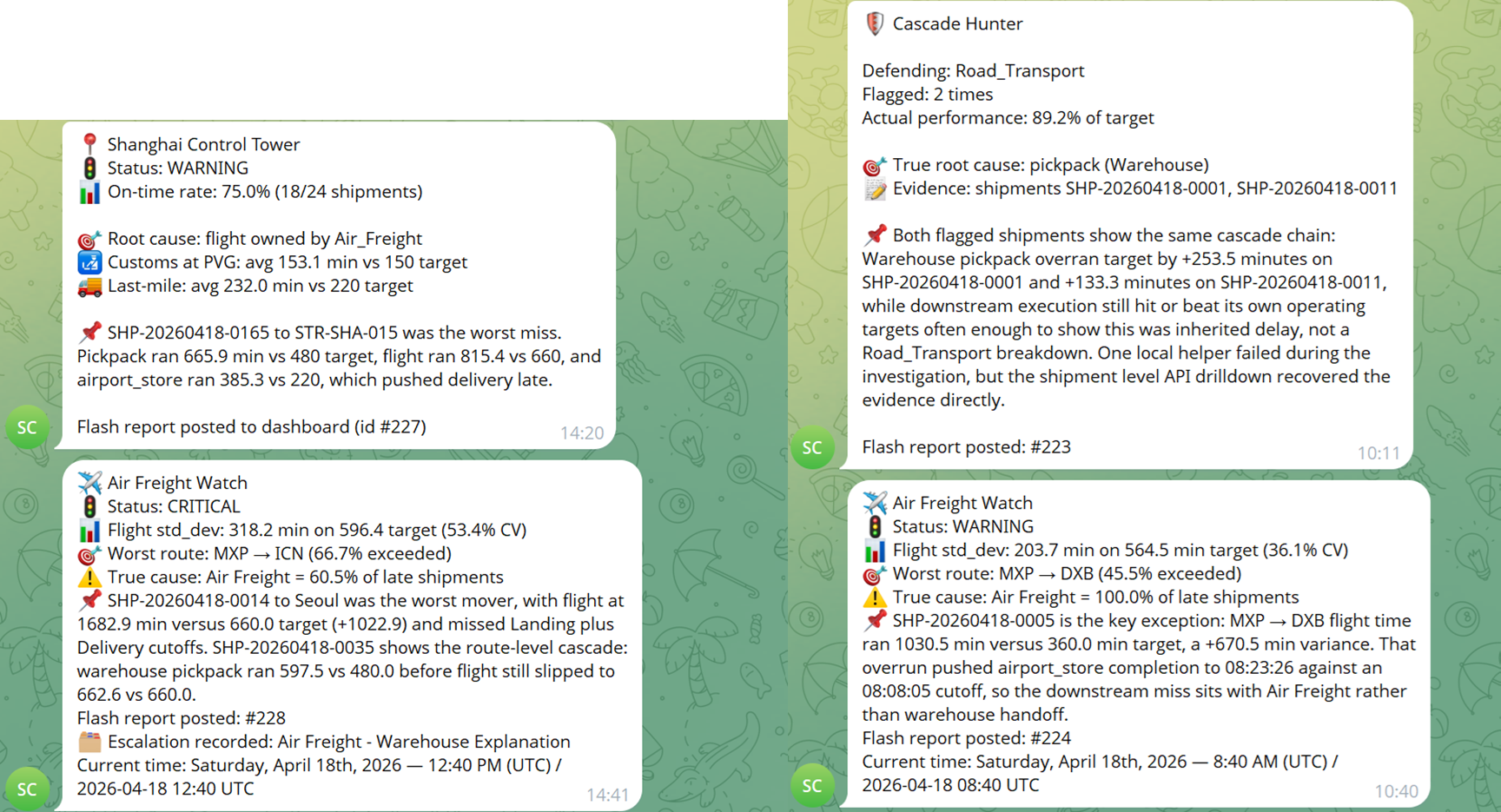
Every late shipment has a name, a root cause, and a responsible team, already documented and ready to discuss.
What Changed for Mario
A few weeks after the agents were connected to his Transportation Management System, Mario's week looks different.
Before OpenClaw, my Mondays were a war zone. Now I get the brief at 8am.
Monday meetings are now 20 minutes, not 2 hours.
Instead of each team showing up with its own version of the truth, Mario walks in with a consolidated brief already written by the agents.
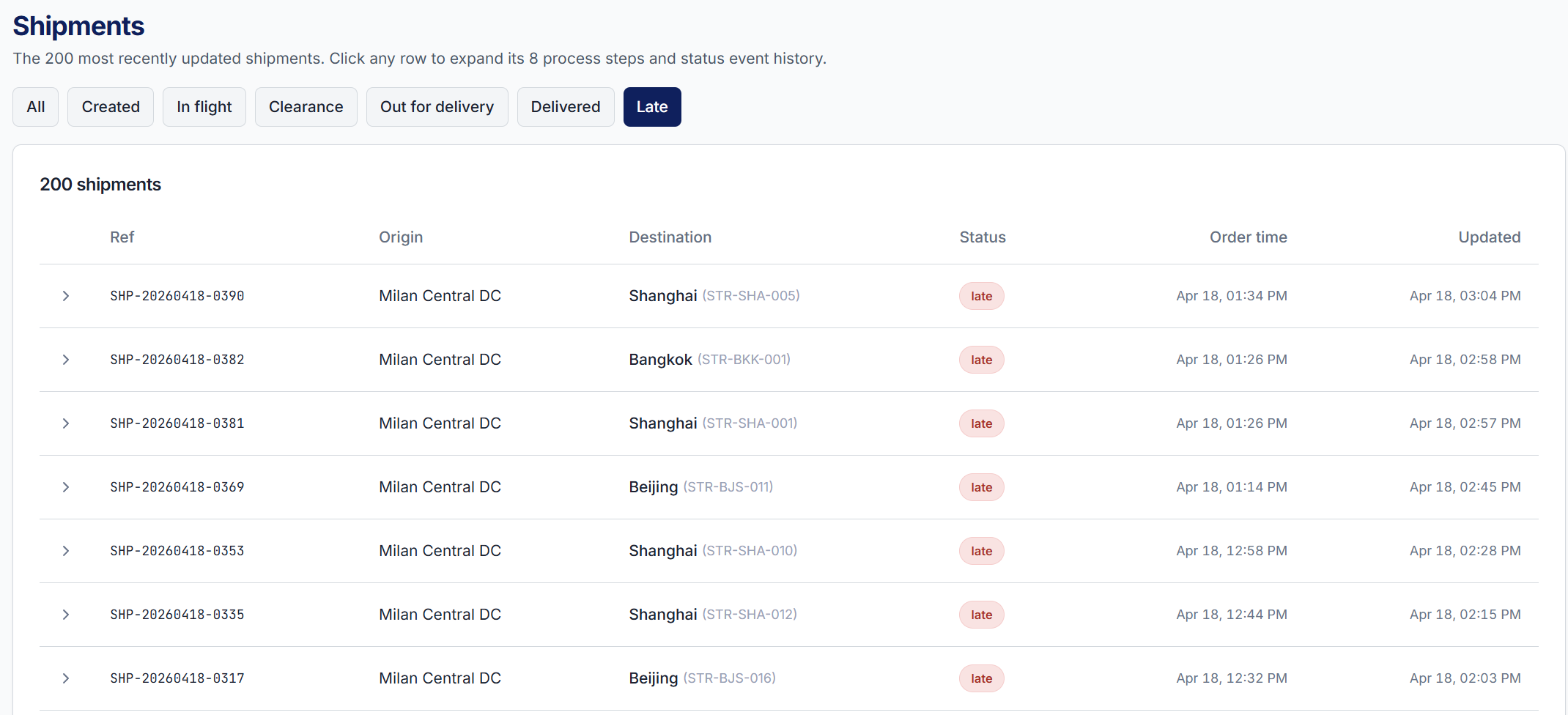
Every late shipment has a name, a documented root cause, and a responsible team. The meeting is about what to fix next, not who to blame.
Local Managers can answer the complaints of their stores without asking Mario for support.
Regional teams get local visibility.
Li Wei, sitting in Shanghai XinTianDi office, receives the same type of reports as Omar, who monitors shipments from Dubai's Marina.
Each local logistics manager receives a targeted daily briefing on their own stores, in their own scope.
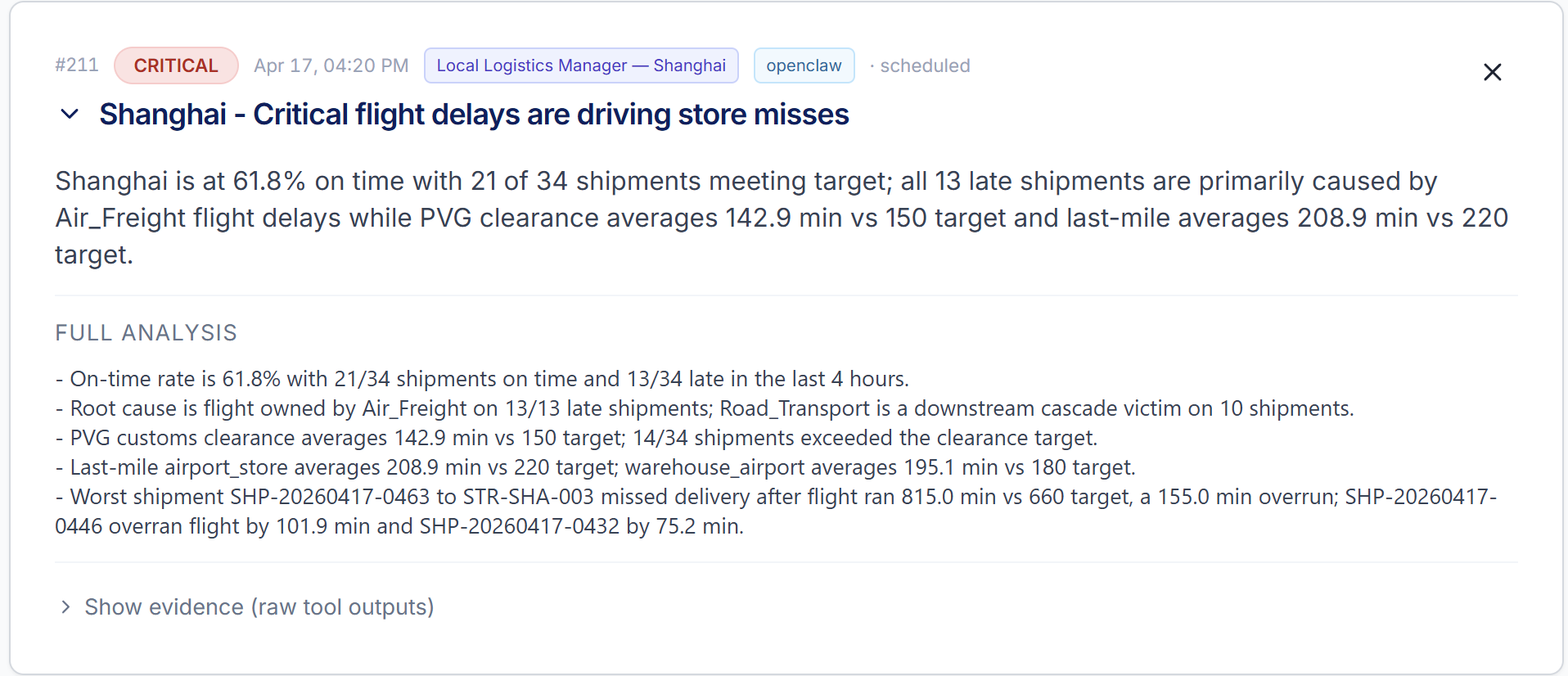
The report also includes two additional outputs: TOOLS CALLED and METRICS that can be used, on demand by OpenClaw, to reconstitute the data transformation that led to the results here.
I wanted to ensure the replicability, so these local managers do not need to wait for Milan to export a filtered CSV.
Problems surface before customers complain.
The agents run every hour, around the clock.
When a flight delay threatens to cascade, the operational team sees it in Telegram before the store manager in Shanghai picks up the phone.
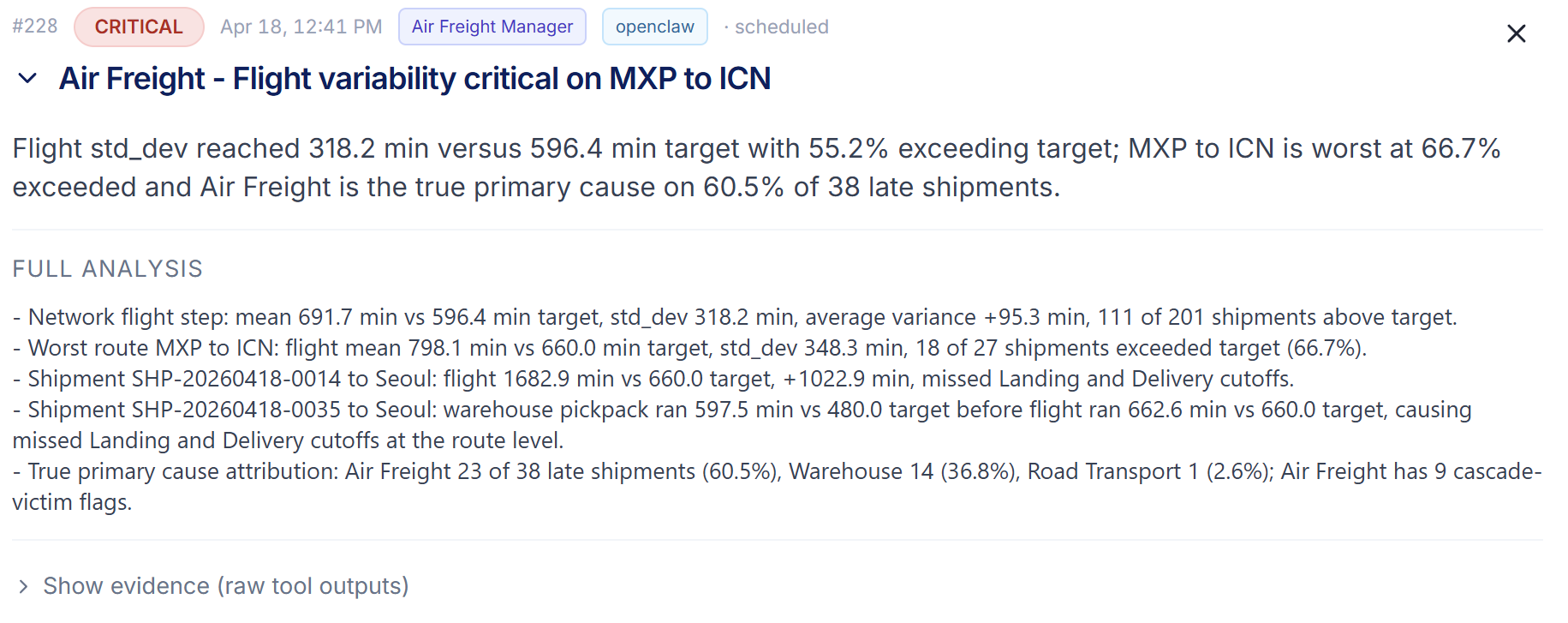
Instead of spending their mornings pivoting CSVs, Mario's analysts can now focus on coordinating with the teams:
- Alert Seoul local logistics teams and stores: "You may face delays for the incoming shipments."
- Ask the Air Freight team when the situation will improve.
The business case is not about replacing analysts.
It is about giving his team the visibility, the evidence, and the time to actually solve the problems their data keeps pointing at.
Conclusion
Should You Let OpenClaw Monitor Your Supply Chain?
We did not pick OpenClaw at random.
Mario was already using it for other automations, so adding supply chain monitoring did not require onboarding a new tool.
OpenClaw runs on their own infrastructure with scoped access to the transportation management system, so sensitive data never leaves their perimeter.
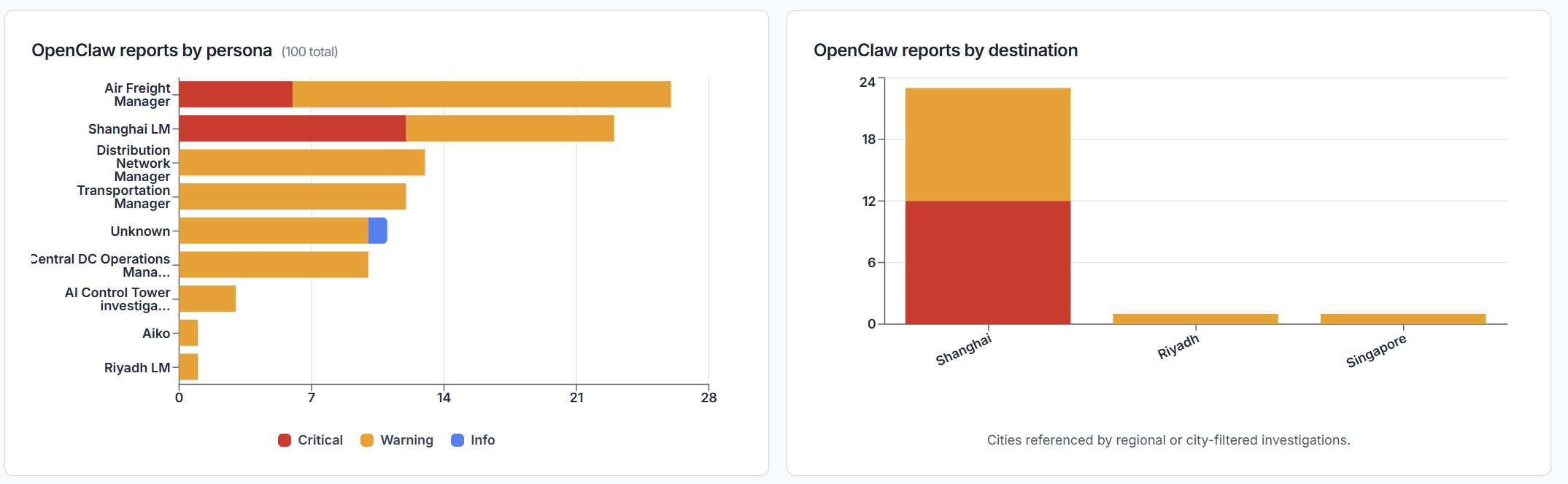
For instance, when his team wants to adjust what Elena checks, they do it in natural language from their Slack channel, without calling a developer.
This exact setup will not fit everybody.
The point of this article is to show what becomes possible when you give AI agents a live 24/7 connection to your operational data and the right tools to query it.
See it live
You can explore the platform yourself at plan.supply-science.com/openclaw
The simulation is running right now with live shipments flowing through Milan to Asia and the Middle East, and OpenClaw's personas are posting flash reports every 4 hours.
Where to go next
- Can AI Solve Failures in your Supply Chain?: When your warehouse and transportation teams blame each other for late deliveries
- How I Deployed an AI Agent for Sustainable Supply Chain Optimisation: Use Claude with an MCP Server to help companies design cost-efficient and sustainable supply chain networks.
- The AI Was the Easy Part: What is a Forward Deployed Engineer for Supply Chain?: In 2012, the Harvard Business Review called the data scientist "the sexiest job of the 21st century." Every company suddenly wanted one.
About Me
Let's connect on LinkedIn and Twitter. I am a Supply Chain Engineer who is using data analytics to improve logistics operations and reduce costs.