Maximize your Business Profitability with Python
Use linear programming to help your local bakery to improve its business profitability by selecting the right items to sell.
In my previous articles, the primary objective was on using Linear Programming, Machine Learning, or Statistics to reduce operational costs.
Because, as a Supply Chain Solution Designer at a 3PL, my mission was always to reduce costs to maintain competitive pricing for our customers.
However, these tools and concepts can maximise profitability by focusing production on high-margin products.
In this article, I will show you how to help your local bakery maximise its profit by producing the right items using Linear Programming with Python.
💌 New articles straight to your inbox for free: Newsletter
Scenario
Problem Statement
You want to help your local bakery maximise its profit.
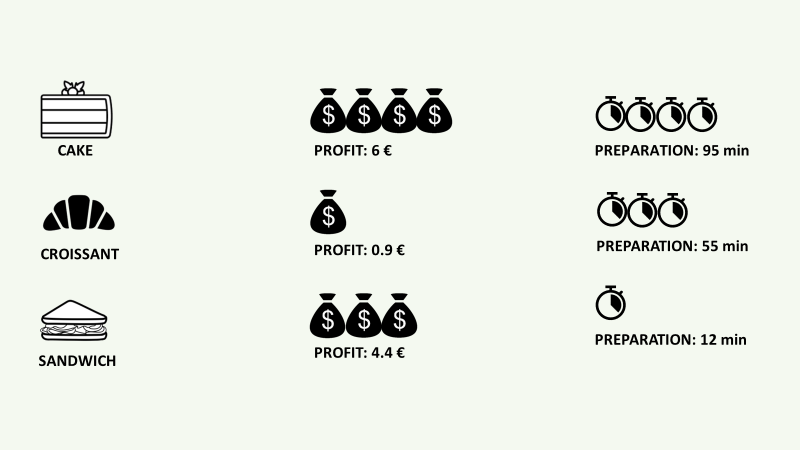
They sell several types of products, including cakes, pastries and sandwiches.
Available resources
- 4 bakers working 6 hours per day (Total: 24 hours/day)
- 1 assistant for sandwiches 4 hours per day
- 2 ovens that can be used 24 hours per day (Total: 48 hours/day)
- 100 slots available for stock and display
These items have different resource needs and profit levels.

Objective
What do you need to produce to maximise your daily profit?
- Results
Sandwich = 20
Chocolate Cake = 32
Croissant = 0
Chocolate Eclair = 0
Panini = 0
Profit reached: 328 euros/day
Based on these results, your local bakery owner should focus on Chocolate Cakes and Sandwiches to reach a maximum profit of 328 euros/day.
This result can be improved by adding more constraints and parameters to ensure your model reflects the realities of your business.
- What is the utilisation ratio of your resources?
Sandwich = 20
Chocolate Cake = 32
Croissant = 0
Chocolate Eclair = 0
Panini = 01,440/1,440 minutes of bakers used
2,880/2,880 minutes of oven used
240/240 minutes of assistants working time used
126/200 display slots
Profit reached: 328.0 euros
Good news! You are fully utilising your equipment and workforce.
- What if we have two more assistants to make sandwiches?
Sandwich = 60
Chocolate Cake = 32
Croissant = 0
Chocolate Eclair = 0
Panini = 0
Profit reached: 504 euros
- 50% profit increase if you recruit two more assistants (4h/day) by selling more sandwiches
The results are clear and backed by data.
How can you implement that for your business?
Build your Model
We will be using the PuLP library of Python.
PuLP is a modelling framework for Linear (LP) and Integer Programming (IP) problems written in Python.
Declare your variables, parameters and model
- LpMaximize: your objective is to maximise your profit
- lowBound =0: you cannot have a negative value of pastries
- cat = ‘Integer’: let’s try to sell entire croissants :)
These parameters can be loaded from an Excel file.
Define the objective and add constraints
Solve your model and analyse the results
The full source code is available here.
Next Steps
Improve your model
Your local bakery cannot stop selling Lemon Cake overnight because it is not profitable.
Therefore, in your model, you can add constraints of a minimum quantity for each item to guarantee that your fans of lemon cake will have their favourite product.
Additional parameters and constraints can be added like ingredients quantity, shelf life.
What about considering the entire value chain?
On my channel, I explain how I used Python modelling to help my friend's small business as an example.

They sell cups made from renewable materials to coffee shops and distributors.
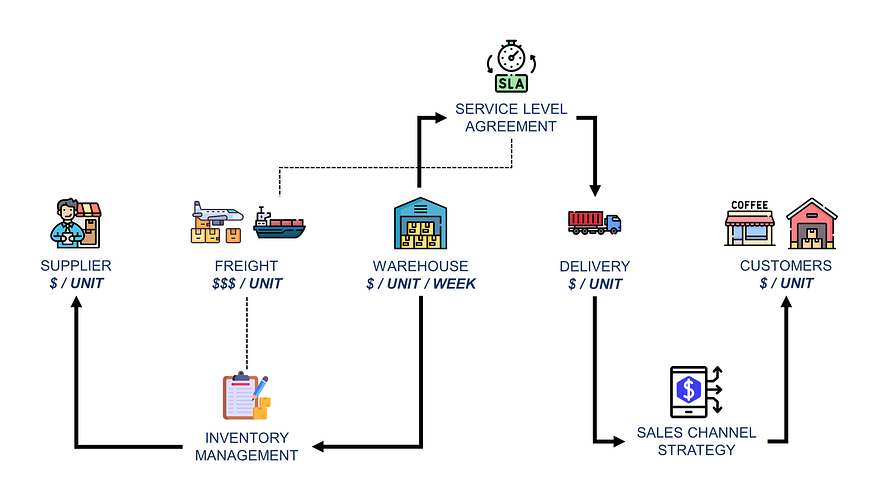
The idea was to simulate the impact of multiple business decisions (selling via distributors, using air freight for replenishment) on the overall profitability and cash flow.
For more details,
Where to go next
- Linear Programming in Supply Chain Management: Five Problems and the Code to Solve Them: The three-part recipe every supply chain optimisation reduces to, and five problems solved with it in Python: network design
- Business Planning with Python — Inventory and Cash Flow Management: How can you use data analytics to help small businesses manage inventory, predict liquidity needs, and maximize profitability?
- Are you Aware of the Potential of Your Data Expertise in Driving Business Profitability?: A reflection of a supply chain data scientist who randomly discovered the power of data analytics to help small and large businesses.
Related videos
The videos behind this article, already on the channel:
About Me
Let’s connect on LinkedIn and Twitter. I am a Supply Chain Engineer using data analytics to optimise logistics operations and reduce costs.